
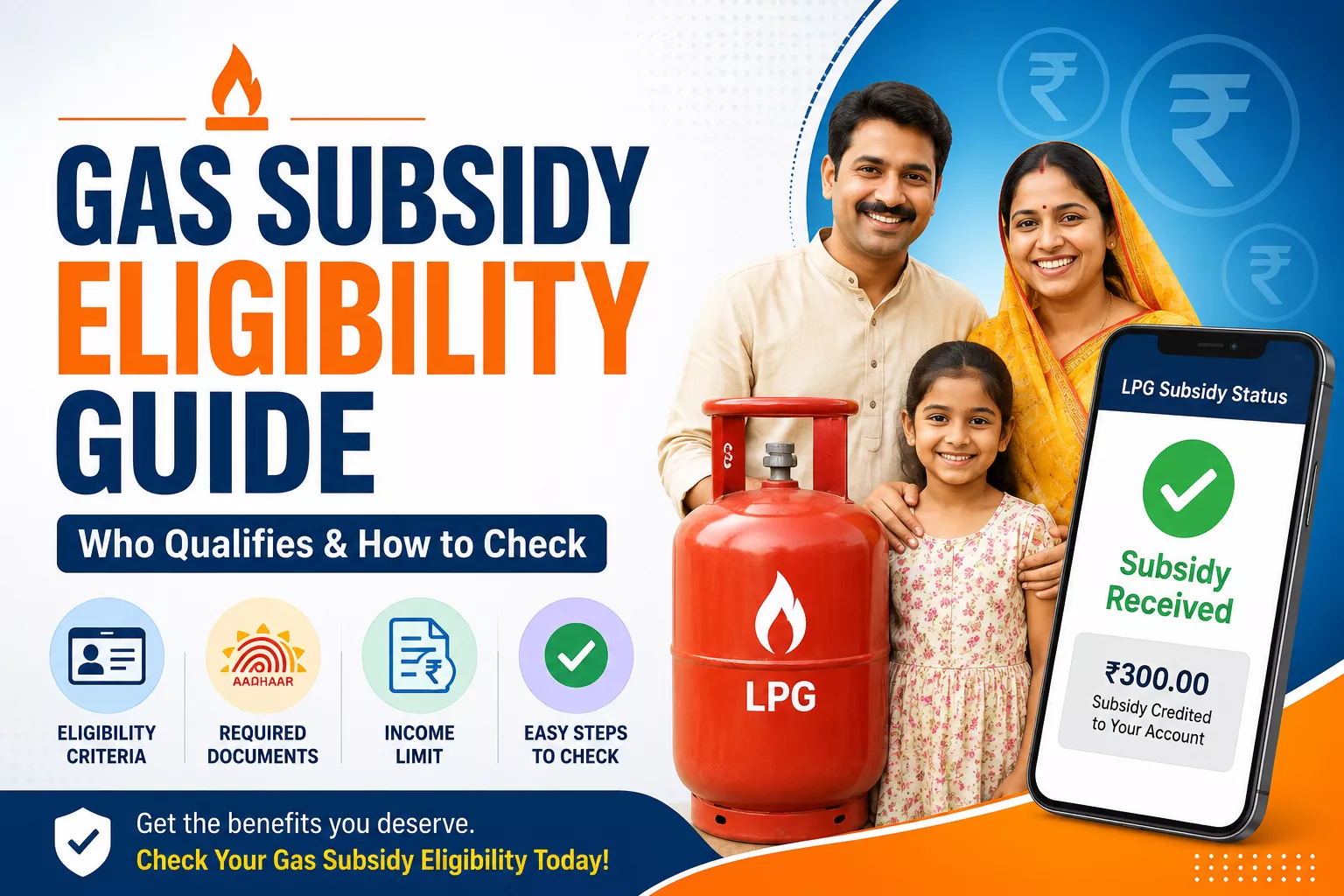
If your LPG subsidy hasn’t shown up in your bank account for a refill or two, or you’re simply trying to figure out whether you qualify for one at all, you’re not alone it’s one of the most common questions Indian LPG consumers search for. The rules involve income limits, Aadhaar-bank linking, and a few scheme-specific conditions that aren’t always explained clearly. This guide breaks down exactly who qualifies, why subsidies stop, and how to check and fix your status, in plain language, without the government jargon.
What Is the LPG Subsidy, Really?
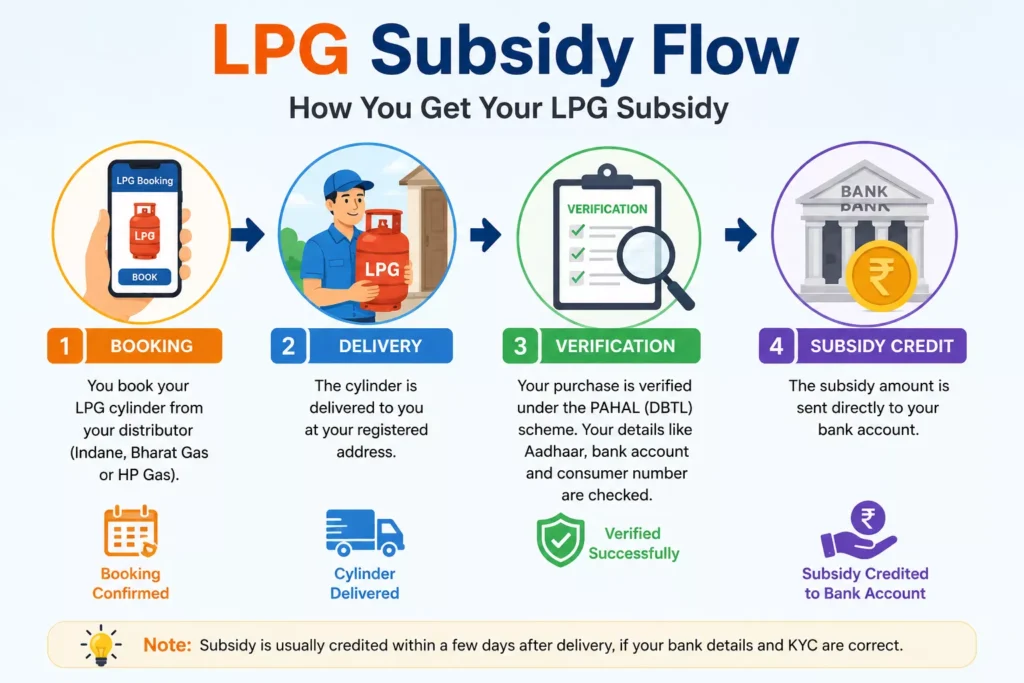
Before we get into eligibility, it helps to understand what you’re actually eligible for. In India, cooking gas subsidies are delivered through a system called PAHAL, short for Pratyaksh Hanstantrit Labh, which basically means “direct benefit transfer.” You might also see it called DBTL (Direct Benefit Transfer for LPG).
Here’s the simple version: you pay the full market price for your LPG cylinder at the time of delivery. Then, if you qualify, the subsidy amount is credited directly into your linked bank account a few days later. This replaced the older system where subsidized cylinders were sold at a lower price upfront, which as it turns out was being misused. People were diverting subsidized domestic cylinders into commercial use, which cost the government a lot of money. The PAHAL scheme was designed to plug that leak by removing the price gap that made diversion profitable in the first place.
Who Is Eligible for LPG Subsidy? The Basic Rules
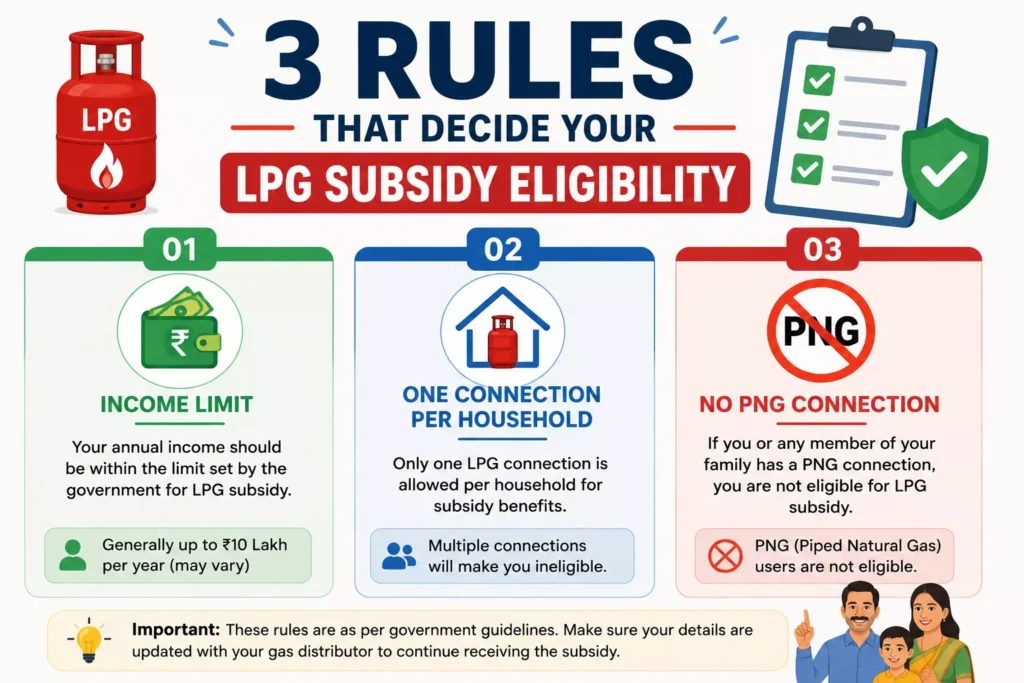
This is the part everyone actually wants to know, so let’s not waste time. There are three big rules that decide whether you’re eligible for gas subsidy in India.
Rule 1: The ₹10 Lakh Income Limit
This is the single biggest factor. If your household’s combined taxable annual income meaning yours plus your spouse’s is more than ₹10 lakh a year, you are not eligible for the LPG subsidy. This isn’t just about your personal salary; it’s the combined figure that counts.
That’s exactly how it works: the government looks at the consumer’s and spouse’s incomes together, not separately. Under the Income Tax Act, 1961, this restriction applies on a combined household basis it’s the consumer’s taxable income plus their spouse’s that gets checked, not either income alone.
So if you’re earning ₹6 lakh and your spouse earns ₹5 lakh, your combined income of ₹11 lakh puts you over the limit, even though neither of you individually crosses ₹10 lakh.
The good part is that OMCs (Oil Marketing Companies like Indane, Bharat Gas, and HP Gas) don’t rely purely on your word for this anymore. They cross-check your PAN and Aadhaar details against Income Tax Department records. If you get flagged, you’ll receive an SMS notice from your OMC, and you typically have 7 days from receiving it to respond or contest the finding failing to respond within that window can result in your subsidy being discontinued.
If your income does cross the limit, or you simply want to voluntarily give up your subsidy to help someone who needs it more, there’s a portal for that too it’s called GiveItUp, and the money saved goes toward funding free connections for low-income women. You can give up your subsidy directly through the official consumer portal at mylpg.in, under your provider’s GiveItUp option, or through your distributor.
Rule 2: Only One Connection Per Household
This one trips people up more than you’d expect. The rule is simple: only one LPG connection is allowed per household, and “household” is defined by who’s listed together on your Ration Card or family certificate.
This commonly happens with a newly married couple who end up with two connections in the same house one from the wife’s side and one from the husband’s without realizing it’s a problem until the subsidy suddenly stops on one of them. If this happens, one connection needs to be surrendered or formally regularized to avoid penalties.
Rule 3: No Piped Natural Gas (PNG) at Home
If your home has switched to Piped Natural Gas, you’re legally required to give up your domestic LPG cylinder connection. This isn’t optional. In fact, OMCs are instructed not to deliver refills to addresses that already have an active PNG connection, specifically to prevent people from hoarding or reselling extra cylinders.
LPG Subsidy Under PMUY vs. General Domestic Consumers
Here’s something a lot of people don’t realize: not everyone is applying for the same kind of subsidy. There are actually two separate tracks, and knowing which one applies to you changes everything.
Pradhan Mantri Ujjwala Yojana (PMUY) is meant for adult women from low-income households, especially those who were previously identified in the SECC 2011 survey or who qualify under a Deprivation Declaration. If you fall into this category, the benefits are much bigger: a fully deposit-free connection, plus a free cylinder security deposit, regulator, hose, first refill, and stove. On top of that, PMUY beneficiaries get a targeted subsidy of ₹300 per 14.2 kg cylinder but the number of subsidized refills has changed more than once. It was reduced from 12 refills a year to 9 for FY 2025-26, and the government further cut it to just 4 subsidized refills a year starting FY 2026-27 (announced June 2026). Refills beyond that number are billed at the regular market price. Because this number has changed multiple times in recent years, always confirm the current limit on mylpg.in or your OMC’s app before relying on it.
General domestic consumers under the regular PAHAL scheme don’t get the free equipment. You pay market rate for your deposit and equipment upfront, and your ongoing subsidy is smaller and tied to your income eligibility rather than your socio-economic category.
If you’re a woman from a low-income household applying for the first time, I’d genuinely recommend checking PMUY eligibility before assuming you fall under general PAHAL. It could save you a meaningful amount of money on your first connection.
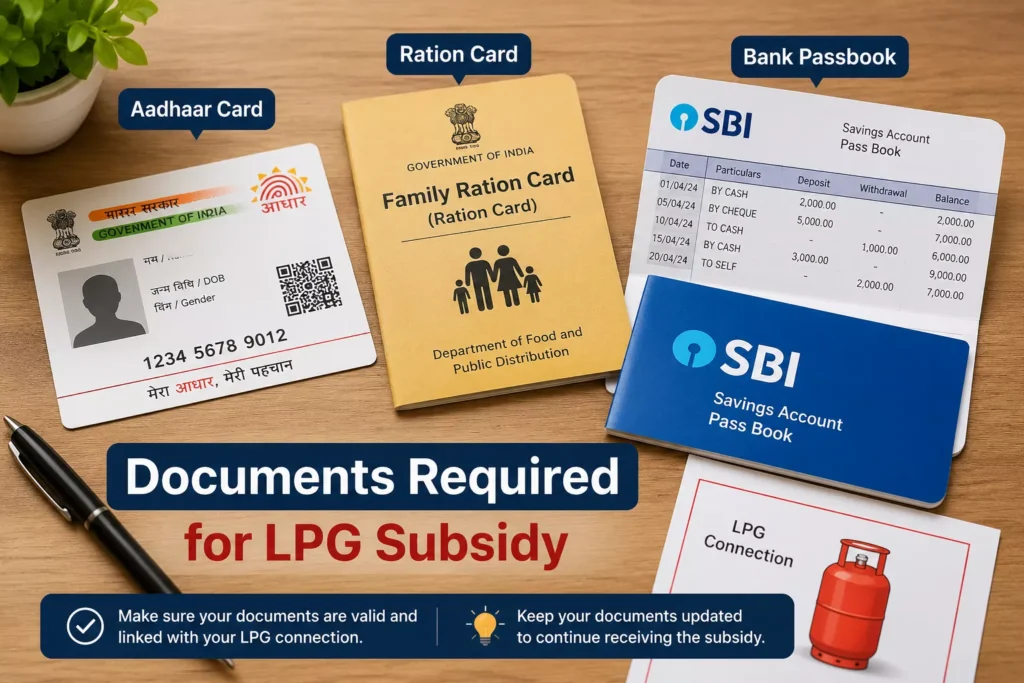
Documents Required for LPG Subsidy (PMUY Application)
If you’re applying under PMUY, keep these ready:
- A completed KYC form
- Your Aadhaar card (as identity and address proof)
- Aadhaar numbers of all adult members in your household
- A valid Ration Card or family composition certificate
- Bank account details, including your IFSC code
For general domestic consumers, the documentation is lighter mainly your Aadhaar (or alternative ID), proof of address, and your bank account details for subsidy seeding, which I’ll explain next. documentation is lighter mainly your Aadhaar (or alternative ID), proof of address, and your bank account details for subsidy seeding, which I’ll explain next.
Why Am I Not Getting My LPG Subsidy? Common Reasons
This is honestly the question I get asked the most, so let’s go through it properly. If your subsidy has stopped or simply isn’t showing up, it’s almost always one of these five reasons.
Your Aadhaar isn’t properly seeded with NPCI. This is probably the most common issue. Your bank might have your Aadhaar on file, but that doesn’t automatically mean it’s mapped correctly on the NPCI (National Payments Corporation of India) system that actually processes the transfer. Even if everything “looks” linked at your bank, the subsidy won’t move unless the NPCI mapper shows your account as enabled for DBT.
You got flagged for the income limit. As we discussed, if the automated system flags your household income as being over ₹10 lakh, your subsidy pauses until you respond.
Your connection has gone dormant. If you haven’t booked a refill in about 9 months, your account can be marked inactive, and subsidy stops until you reactivate it with fresh KYC documents at your distributor.
Your bank account had an issue. Closed account, frozen account, or an incorrect IFSC code any of these will bounce the transfer straight back.
You haven’t completed e-KYC yet. We’ll get into this in detail in the next section, but incomplete biometric verification can eventually affect your subsidy eligibility, especially for PMUY beneficiaries.
The first reason above Aadhaar being linked at the bank but not properly mapped with NPCI is one of the most frequently reported causes of stalled subsidies. A visit to the bank branch to explicitly request Aadhaar seeding for DBT/APB (Aadhaar Payment Bridge) typically resolves it within a week.
Biometric e-KYC: Do You Really Need It?
There’s been a lot of news about mandatory biometric e-KYC for gas cylinder delivery in 2026, and the rules have shifted more than once, so it’s worth being precise about where things currently stand.
As of March 2026, the government clarified that Aadhaar-based e-KYC is required for domestic LPG consumers who haven’t completed it before if you already did biometric verification when you first got your connection (or during an earlier update), you generally don’t need to repeat it unless something flags your identity for review.
For consumers who hadn’t completed e-KYC, oil marketing companies set August 16, 2026 as the compliance deadline, warning that unverified connections could be billed at commercial rather than domestic rates until verification is completed. If you’re reading this after that date and haven’t done your e-KYC, check your connection status directly in your OMC’s app rather than assuming what will happen reports at the time suggested connections would not be cancelled outright, but rates and subsidy eligibility could be affected.
For PMUY beneficiaries specifically, e-KYC is required once every financial year to keep receiving the targeted DBT subsidy. Note that the number of subsidized refills has also been cut from 9 refills a year (FY 2025-26) to just 4 refills a year (FY 2026-27, effective June 2026) so any guidance tied to a “7th, 8th, or 9th refill” trigger reflects the older 9-refill structure and should be reconfirmed against the current cap.
Non-PMUY consumers who complete e-KYC generally see it apply to ongoing eligibility rather than blocking an already-scheduled delivery, but policy on this has been clarified and re-clarified multiple times in 2026, so check current guidance on your OMC’s app or mylpg.in before assuming either way.
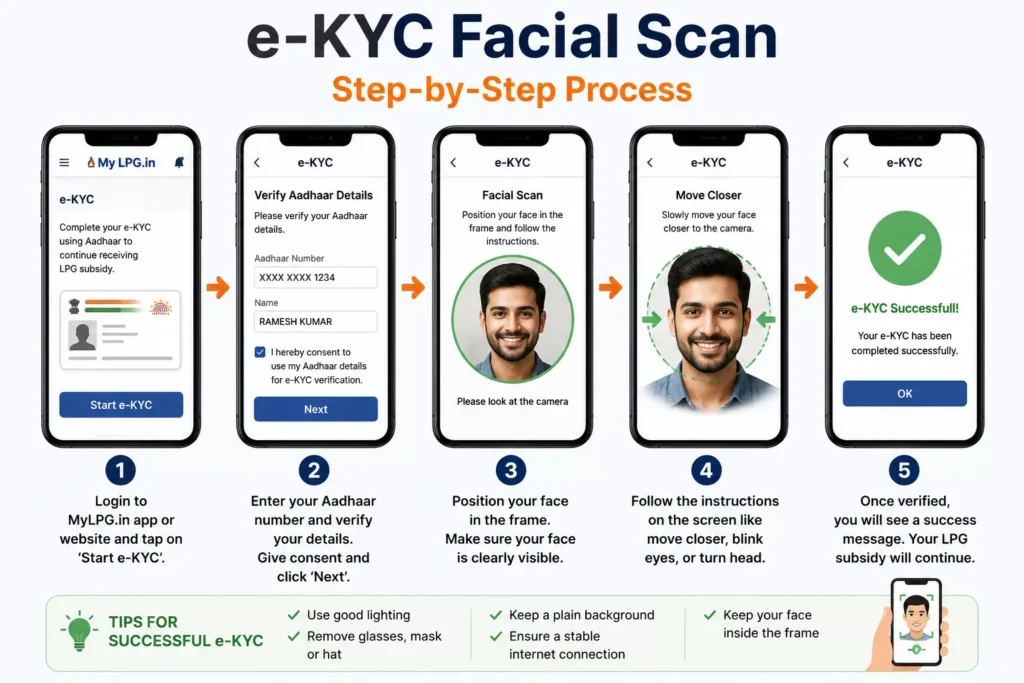
How to Complete e-KYC From Home
You genuinely don’t need to visit your distributor’s office for this anymore. Here’s what you do:
- Download your OMC’s app IndianOil ONE for Indane, HelloBPCL for Bharat Gas, or HP PAY for HP Gas along with the UIDAI Aadhaar FaceRD app.
- Log in to the OMC app using your registered mobile number.
- Go to the e-KYC or Aadhaar Authentication section.
- Enter your Aadhaar number and the OTP sent to your Aadhaar-linked mobile.
- The app will open Aadhaar FaceRD automatically sit somewhere well-lit, look directly at the camera, and blink when prompted.
- Once verified, your account updates to show biometric verified status.
The process is designed to take under five minutes once you’re in a well-lit spot. If your phone camera struggles to detect your face, moving to a spot with more natural light rather than a dim room is generally what resolves it.our phone camera struggles to detect your face, try moving to a spot with more natural light rather than a dim room that’s usually what fixes it.
How to Check Your LPG Subsidy Status Online
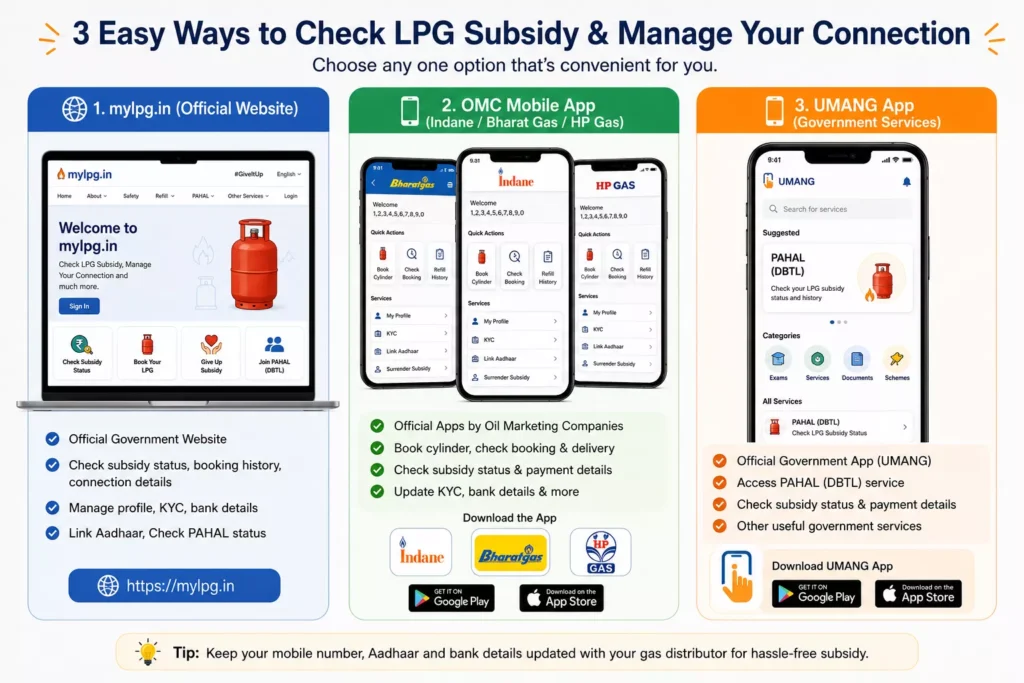
Once you know you’re eligible, the next natural question is: how do you actually check whether the subsidy is coming through? There are three easy ways to do this, and I’d recommend trying at least one every couple of months just to stay on top of things.
Method 1: The mylpg.in Portal
This is the official central hub for all three gas providers.
- Go to www.mylpg.in
- Select your provider Indane, Bharat Gas, or HP Gas
- Find your 17-digit LPG ID (there’s a “know your LPG ID” link if you don’t have it handy)
- Log in with your LPG ID and registered mobile number
- Click “Check PAHAL (DBTL) Status” to see your full transaction history, subsidy amounts, and bank reference numbers
Method 2: Your OMC’s Mobile App
Each company has its own app:
- Indane users check via the IndianOil ONE app under “Order History” or “Subsidy Status”
- Bharat Gas users check via HelloBPCL, under “Check Subsidy Status / Refill History”
- HP Gas users check via HP PAY, under “eKYC & Subsidy History”
Method 3: The UMANG App
UMANG is a single government app that covers all three providers in one place, which is handy if you don’t want three separate apps cluttering your phone. Search for your OMC inside the app, select “Check Subsidy / Refill History,” and enter your consumer number.
What to Do If Your Subsidy Still Isn’t Showing Up
If you’ve checked your status and the portal actually confirms a subsidy was transferred, but it’s genuinely not showing up in your bank account, don’t just wait it out file a formal complaint using Form 6, the Grievance Redressal Form for the PAHAL Scheme.
You can get this form from your distributor or download it from mylpg.in. Fill in your LPG ID, consumer number, distributor name, bank account number, IFSC code, and the refill transaction date, then submit it to your distributor, or lodge it electronically through the MOPNG E-seva platform. There’s also a dedicated helpline for this: 1800-2333-555.
For anything related to a closed or incorrect bank account, submitting Form 4 with your updated bank details to your distributor is usually the fastest fix.
A Quick Compliance Checklist Before You Go
Before you close this tab, here’s a short list worth bookmarking:
- Keep your combined household income under ₹10 lakh, and respond to any income tax notices within 7 days.
- Stick to one LPG connection per household, and surrender it if you switch to PNG.
- Confirm your CTC (Cash Transfer Compliant) status on mylpg.in.
- Complete your e-KYC if you haven’t already, especially if you’re a PMUY beneficiary.
- Check your subsidy transfers every couple of months, and use Form 6 if there’s a mismatch.
Gas subsidy eligibility in India isn’t as complicated as it first looks once you break it down into these pieces. Most of the time, when a subsidy stops, it’s a small technical hiccup a mapping issue, a pending e-KYC, or an income flag rather than something permanent. Because refill limits, subsidy amounts, and e-KYC deadlines have changed multiple times through 2026, it’s worth checking your current status on mylpg.in or your OMC’s app every couple of months rather than assuming last year’s rules still apply.