
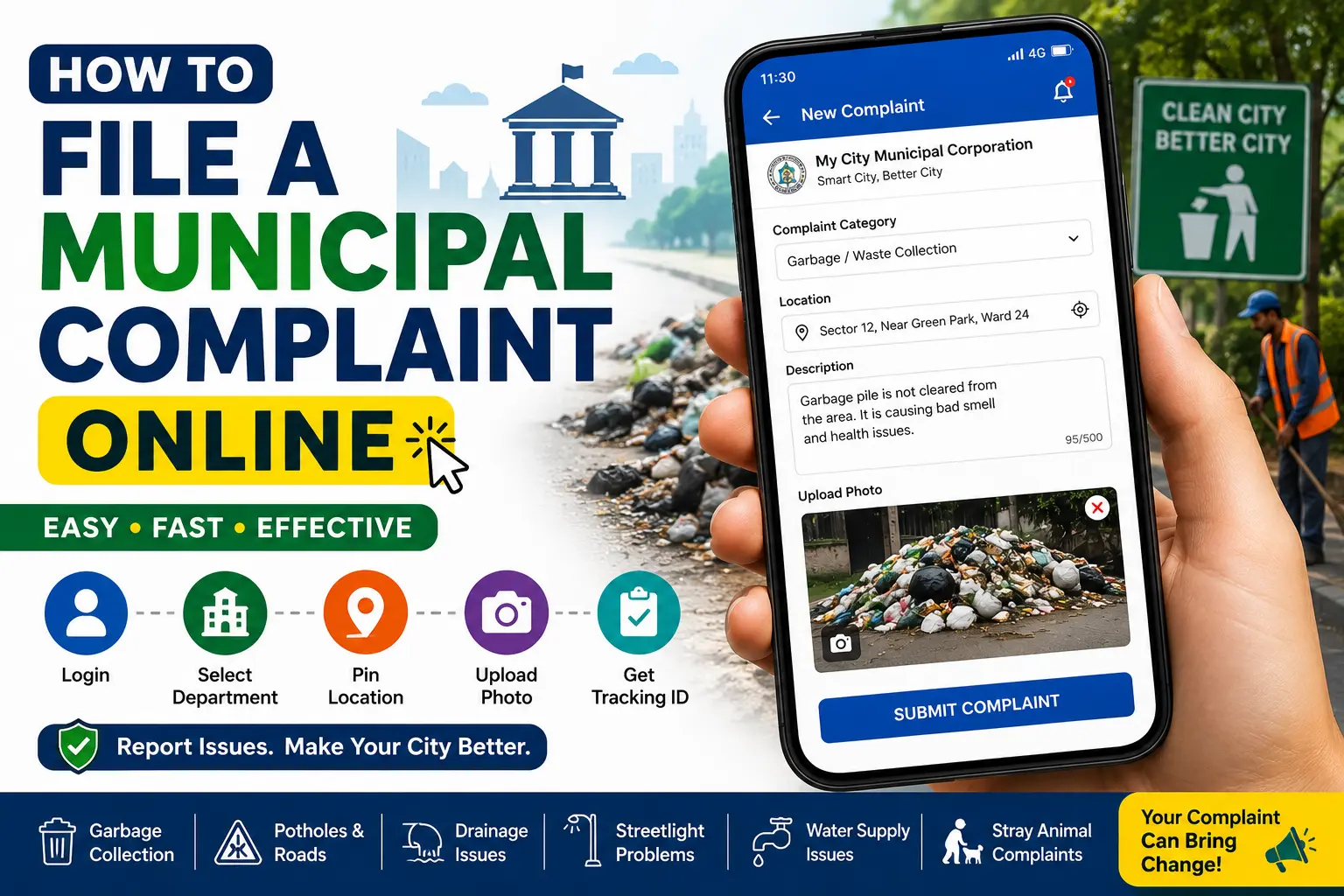
How to File a Municipal Complaint Online in India (And Actually Get It Fixed)
A pothole outside your society, a streetlight that’s been dead for weeks, a drain that overflows every monsoon almost every Indian city now has some kind of digital system to report these. Yet most people either don’t know it exists or don’t trust it enough to use it, partly because tickets sometimes get marked “resolved” while the problem is still sitting right there.
This guide covers registering a municipal complaint online in India which portal works for which city, how long you should realistically wait before pushing back, and what to actually do when the system lets you down.
Why I Stopped Calling the Ward Office and Started Filing Online
Calling the ward office or asking a local corporator’s assistant to “look into it” is many people’s first instinct with a civic issue. Both approaches work sometimes, but neither gives you anything to hold on to if nothing happens. There’s no reference number, no timestamp, no proof that you even reported the problem.
An online complaint to municipality authorities does one thing a phone call never can it creates a paper trail. The moment you submit a civic complaint online, the system generates a unique tracking reference number along with an SMS or email confirmation. That number becomes your evidence. If the issue isn’t fixed in a reasonable time, you have something concrete to escalate with, instead of a vague memory of “I called someone in March.”
Most municipal corporations today run these systems through a mix of web portals, dedicated mobile apps, toll-free helplines, and Customer Relationship Management (CRM) software that assigns your complaint automatically to the right department and ward officer. It’s not a perfect system I’ll get into the glitches later but it’s a massive improvement over shouting into the void.
How Municipal Complaint Portals Actually Work Behind the Scenes
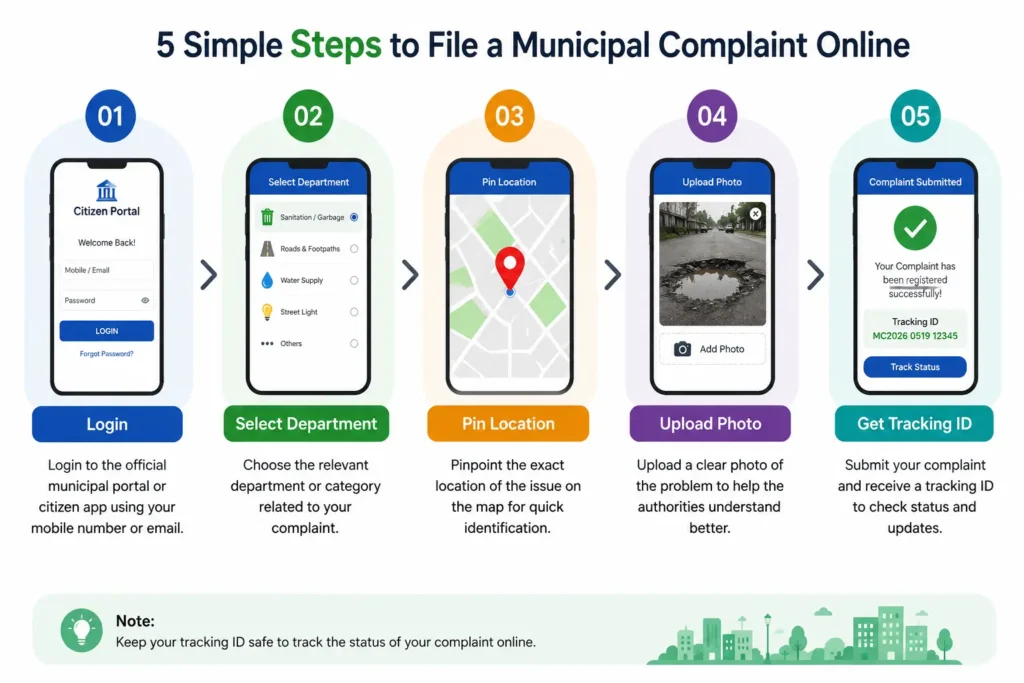
Every city’s portal looks a little different, but the underlying process is almost identical everywhere. Understanding this flow helps you fill in the right details the first time, so your complaint doesn’t get stuck or bounced back.
Step 1: Log In With Your Mobile Number
Nearly every portal starts with a 10-digit mobile number and an OTP. Some state-level systems let you create a full profile so you can track multiple complaints from one account over time useful if you end up reporting more than one issue in your area, which, let’s be honest, most of us eventually do.
Step 2: Pick the Right Department
This step matters more than people realise. You’ll usually see a dropdown list Solid Waste Management, Drainage and Stormwater, Roads and Traffic, Street Lighting, Public Health, Building and Factory Oversight, and so on. Picking the correct category is what routes your municipal corporation complaint to the right ward officer’s queue automatically. Choose the wrong department, and your complaint can sit unnoticed for weeks before someone reassigns it.
Step 3: Pin Your Exact Location
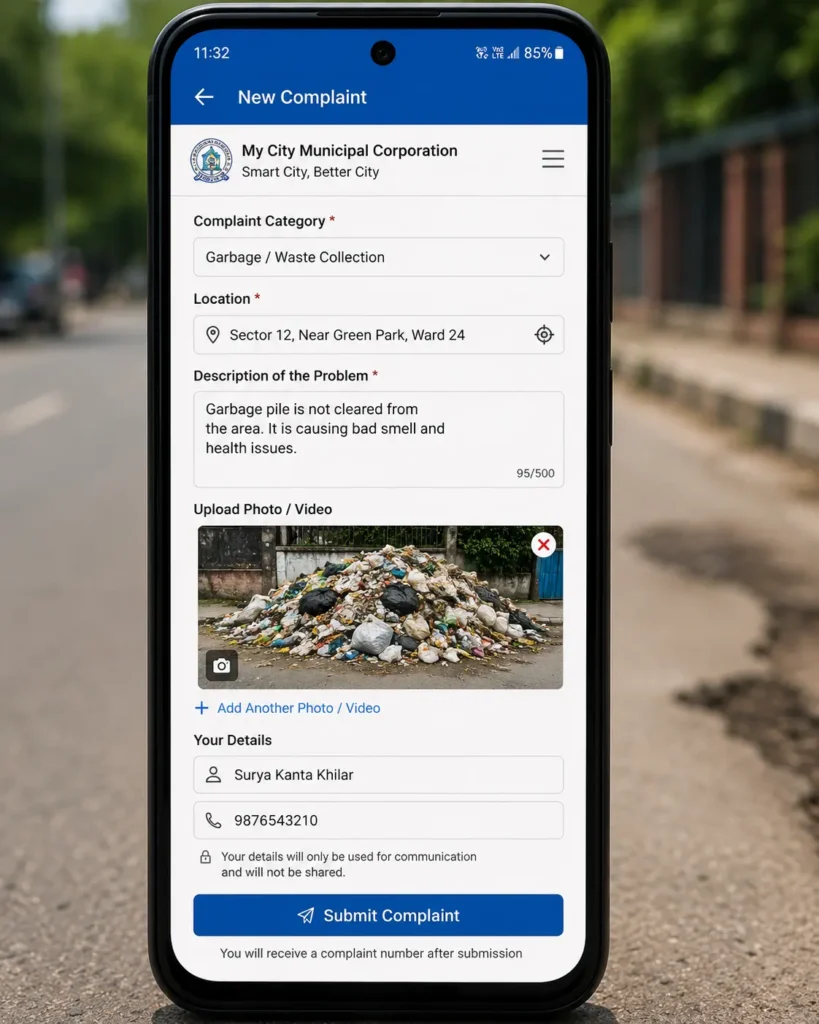
Accurate location details decide whether a field team actually finds the issue. Select your zone, ward number, and locality carefully. If you’re using a mobile app, let it access your GPS so it pins the exact coordinates on the municipal map this alone can save you from a “we couldn’t locate the site” excuse.
Step 4: Attach Clear Photos as Proof
Always attach a photo, and try to include a landmark in the frame a shop signboard, a house number, a distinctive gate. Complaints without a clear landmark are one of the most common reasons field teams close a ticket with “location could not be verified,” even when the issue is real.
Step 5: Save Your Tracking ID
Once you submit, you’ll get a unique reference number instantly. Screenshot it, save the SMS, do whatever you need to do this ID is what you’ll use for every future status check and, if needed, every escalation.
Which Municipal Complaint Portal Should You Use for Your City?
This is usually where people get stuck not everyone knows their city has a dedicated app, or which one it is. Here’s a quick reference for some of the bigger municipal corporations.
Municipal complaint portals, apps, and helplines by city
| City / Authority | Web Portal | Mobile App | Helpline |
|---|---|---|---|
| Mumbai (BMC/MCGM) | mcgm.gov.in | MyBMC | 1916 |
| Pune (PMC) | pmc.gov.in | PMC Care | 1800-103-0222 |
| Ahmedabad (AMC) | ahmedabadcity.gov.in | AMC CCRS | 155303 |
| Delhi (MCD) | mcdonline.nic.in | MCD 311 | 155305 |
| Chennai (GCC) | chennaicorporation.gov.in | Namma Chennai App | 1913 |
| Rajkot (RMC) | rmc.gov.in | RMC Citizen App | 155304 |
If your city isn’t listed here, don’t worry nearly every state has a fallback grievance portal that routes complaints to your local municipal body even if the city-specific app isn’t well known. I’ve listed several of these further down.
In Ahmedabad specifically, it’s worth knowing that AMC’s Comprehensive Complaint Redressal System (CCRS) and the AMC Seva (Ahmedabad 311) app are two separate systems, not the same thing CCRS is AMC’s own grievance platform (call centre 155303, web portal via amccrs.com), while AMC Seva is a citizen-reporting app built by a third-party developer. Either works, but if one glitches, you can also walk into a physical Civic Center with your complaint reference and get help in person.
How Long Should You Actually Wait? Understanding SLA Timelines
A common question after filing a complaint is, “I filed this three days ago, why hasn’t anyone come?” The answer is that different civic issues have different Service Level Agreements (SLAs) the maximum time a department is supposed to take to resolve a complaint. Knowing these numbers saves you a lot of unnecessary anxiety, and also tells you exactly when it’s fair to start pushing back.
Typical SLA resolution windows by complaint type
| Type of Complaint | Typical SLA Window |
|---|---|
| Garbage pickup, dead animal removal | 24–48 hours |
| Streetlight or electrical faults | 24–72 hours |
| Water supply and minor drainage blockages | 24–72 hours |
| Pothole and road surface repairs | 7–15 days |
| Major road resurfacing | 30–90 days |
| Illegal construction/encroachment | 15–30 days |
| Property tax mutation (e-Mutation) | Up to 30 days |
Note: these are typical ranges actual SLAs vary by city and department, so check your local portal’s citizen charter for exact figures.
Some cities have gone further with structured tracking. Surat Municipal Corporation, for instance, uses a card-based system White Card complaints (14 sanitation and public health categories) must be resolved in 24–48 hours, while Red Card complaints (13 Public Health Engineering categories) get a 3–7 day window. SMC reports that around 96% of complaints are attended to within these windows. It’s a more transparent model than most cities offer.
The “Complaint Closed But Nothing Fixed” Problem And What Actually Works
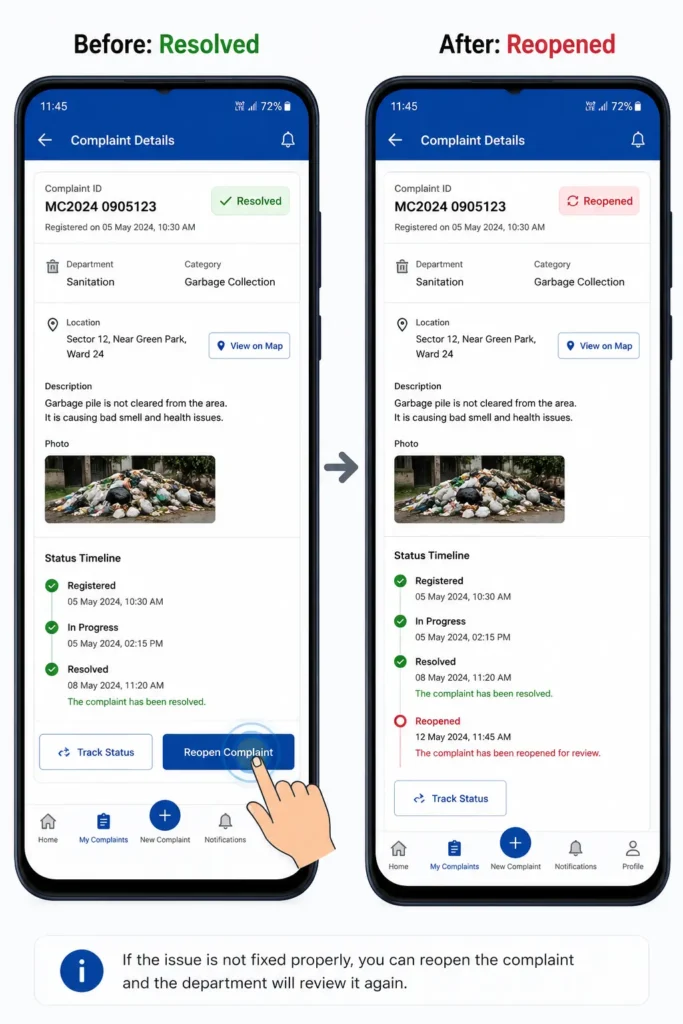
Here’s something nobody tells you before you start filing complaints online: sometimes the ticket gets marked “Resolved” without anyone actually visiting the site. This isn’t rare either field staff are often measured on how quickly they close tickets, and that pressure sometimes leads to premature closures.
This is a documented pattern across Indian municipal systems, not just anecdotal field staff closing tickets before verifying the fix has been flagged repeatedly in citizen and civic-tech reporting. It tends to show up more with routine tasks (garbage pickup, minor pothole fills) than with bigger structural issues like road resurfacing or encroachment removal, which are harder to fake a resolution for.
So what should you do when this happens?
The single most effective thing is reopening the ticket immediately, right within the app, the moment you get an unverified “Resolved” notification. This flags the complaint for supervisory review and makes it much harder for anyone to quietly log a false resolution. Pair this with a fresh, timestamped photo of the same spot, so there’s no ambiguity about whether the work happened.
If the app itself is misbehaving some regional portals are known to reset mid-upload or have login issues social media becomes a surprisingly effective backup. Posting a clear photo with your location and original ticket number, while tagging the Municipal Commissioner’s handle and the corporation’s official account, has become a common escalation tactic that often gets faster attention than the formal channels.
What to Do When Nobody Responds: The Escalation Ladder
If your SLA window has passed and your municipal grievance portal complaint is still sitting untouched, it’s time to escalate and there’s a fairly clear ladder to climb here rather than just complaining louder in the same place.
Start with the Ward Officer or Ward Executive Engineer directly, quoting your complaint reference number. If that goes nowhere, the next step is a written representation to the Zonal Assistant Commissioner overseeing your area. Beyond that, a formal representation to the Municipal Commissioner’s office ideally sent by Speed Post with Acknowledgment Due, or through the Commissioner’s public grievance email creates a proper paper trail. If even that stalls, involving the elected Mayor’s office or the local Standing Committee handling public works can add political pressure that internal departments tend to respond to faster.
If none of this works, the Centralized Public Grievance Redress and Monitoring System, or CPGRAMS, is your next stop. You can file directly at pgportal.gov.in. Even though municipal bodies technically fall under state and local jurisdiction, a CPGRAMS complaint about continued inaction routes the ticket through the central or state administrative reform cell straight to the Municipal Commissioner’s office, and forces a status update. DARPG’s current guideline (revised in August 2024) sets a maximum resolution window of 21 days, though actual timelines vary by department. If you get an unsatisfactory or clearly automated response, you can file an immediate secondary appeal that pushes the case to a higher appellate officer.
What to Do If You Want to File a Complaint Against Municipality Officials
For genuinely stuck cases repeated false closures, months of inaction, or suspected corruption there are proper legal tools available, and more people should know about them.
Use the RTI Act to Demand Records
The Right to Information Act, 2005 is far more useful here than most people realise. Municipal corporations are legally classified as “Public Authorities” under the Act, which means they must disclose internal records if asked properly. You can file an RTI application under Section 6(1) to the Public Information Officer of the relevant ward or department. The fee is commonly ₹10 under Central RTI Rules, but municipal corporations fall under state RTI rules, and fees vary by state check your state’s RTI rules before applying, and note that payment methods (Indian Postal Order, demand draft, or online via state RTI portals) also vary by state.
The trick is asking for specific, quantifiable records rather than vague explanations. Consider requesting the daily progress log for your complaint reference number, the names and designations of officers assigned to the case, certified copies of Action Taken Reports and site inspection logs, and this one’s important the official reason for SLA non-compliance if no work was done. Under Section 7(1), the officer must respond within 30 days, and officials who withhold information or provide false records can face financial penalties under Section 20.
Consumer Protection Act for Paid Services
Municipal bodies often argue civic maintenance is a “sovereign function” and outside consumer law but this doesn’t apply when you’ve paid a specific fee for a service, like water charges, property tax, or a trade license, under Section 2(42) of the Consumer Protection Act, 2019. If the service wasn’t delivered despite payment, you can call the National Consumer Helpline at 1915 for informal mediation, or file a formal case for compensation at the District Consumer Disputes Redressal Commission through e-jagriti.gov.in, which handles claims up to ₹50 lakh.
For Corruption or Environmental Harm
If the issue involves suspected corruption, you can approach your state’s Lok Ayukta, or the Central Vigilance Commission for projects funded under central schemes like Swachh Bharat or AMRUT whistleblowers are protected under the PIDPI resolution. For environmental issues like sewage discharge into water bodies or illegal dumping, the National Green Tribunal handles urgent enforcement orders. And for severe, sustained municipal failure affecting basic rights, a Writ of Mandamus under Article 226 of the Constitution lets citizens or Resident Welfare Associations approach the High Court to compel the Municipal Commissioner to act.
Quick State-Wise Portal Directory
If your city didn’t appear in the earlier table, here are a few more state-level systems worth knowing about.
State-wise municipal grievance portals and helplines
| State | Portal | Helpline |
|---|---|---|
| Karnataka (Bengaluru) | bbmp.gov.in — now under the Greater Bengaluru Authority (GBA), formed after BBMP’s 2025 restructuring | 1533 |
| Telangana (Hyderabad) | ghmc.gov.in — note GHMC was split into three separate corporations in early 2026, so check which one covers your area | 040-21111111 |
| West Bengal | kmcgov.in — Kolkata Municipal Corporation’s civic complaints portal (not the state OBPAS portal, which is specifically for building-plan approvals) | Check KMC’s current published helpline |
| Uttar Pradesh | jansunwai.up.nic.in | 1076 (CM Helpline) |
| Rajasthan | sampark.rajasthan.gov.in | 181 |
| Andhra Pradesh | spandana.ap.gov.in — Spandana grievance portal (MeeSeva is a general government-services portal, not the complaint system) | Check Spandana’s current published helpline |
A note on this table: municipal helplines and portals change fairly often, and a couple of entries above (West Bengal, Andhra Pradesh) couldn’t be independently confirmed at the time of writing verify directly with the respective corporation before publishing final numbers.
My Quick Checklist Before You Hit Submit
Before you hit submit, run through this checklist:
- Make sure your photo shows a clear landmark, not just the problem itself.
- Double-check you’ve picked the correct department a wrong category is one of the most common reasons complaints get stuck.
- Screenshot the tracking ID the moment it’s generated, before closing the app.
- Set a reminder for the SLA date relevant to that category, so you know exactly when it’s fair to start escalating instead of just wondering.
Frequently Asked Questions
Clear answers on filing civic complaints, tracking service requests, statutory timelines, and official escalation pathways.
Is there any fee to register a municipal complaint online?
No — filing a civic complaint through your city’s official portal, app, or helpline is free. There’s no charge for reporting a pothole, garbage pile, or dead streetlight. (Unrelated processes like RTI applications carry their own small fee, but that’s separate from complaint filing.)
How do I check my municipal complaint status?
Use the reference number you received at submission — check it in the portal or app’s status/tracking section, or call the toll-free helpline and quote it. Most systems also send automatic SMS or email updates as the status changes.
What if my complaint keeps getting closed without any actual work?
Reopen the ticket right away if your portal or app allows it — most give you a short window (often 24–72 hours) after a “Resolved” status to do this. Attach a fresh, dated photo of the same spot. If reopening isn’t available or doesn’t help, escalate through the ladder: Ward Officer → Zonal Assistant Commissioner → Municipal Commissioner’s office → CPGRAMS.
Can I file a complaint against municipality officials directly?
Yes. Options include escalating through the corporation’s own vigilance or public grievance cell, filing an RTI to demand action-taken records, approaching the state Lok Ayukta or Central Vigilance Commission for suspected corruption, or — for serious, sustained inaction — filing a Writ of Mandamus under Article 226 in the High Court.
Which is faster: the app or the toll-free helpline?
It varies by city and issue type — there’s no universal answer. Apps and portals give you a written, trackable reference number by default, which matters more for escalation than raw speed. Helplines can be faster for genuinely urgent issues since a person handles it live. For anything you might need to escalate later, use the portal so you have a paper trail.
Final Thoughts
Filing a municipal complaint online isn’t complicated once you know the basic flow pick the right department, pin the exact location, attach a clear photo, and save your tracking number. The part that actually takes patience is what happens after you submit: knowing the right SLA window, recognising when a “resolved” status doesn’t match reality, and understanding you have a real escalation ladder from the ward officer all the way up to CPGRAMS and, if needed, the courts.
Not every complaint resolves quickly some take a single day, others take months and an RTI application to finally move. But the ones that do get fixed almost always share the same pattern: a tracking number, photographic evidence, and a clear next step when the first attempt doesn’t work. That’s the throughline of this guide.