

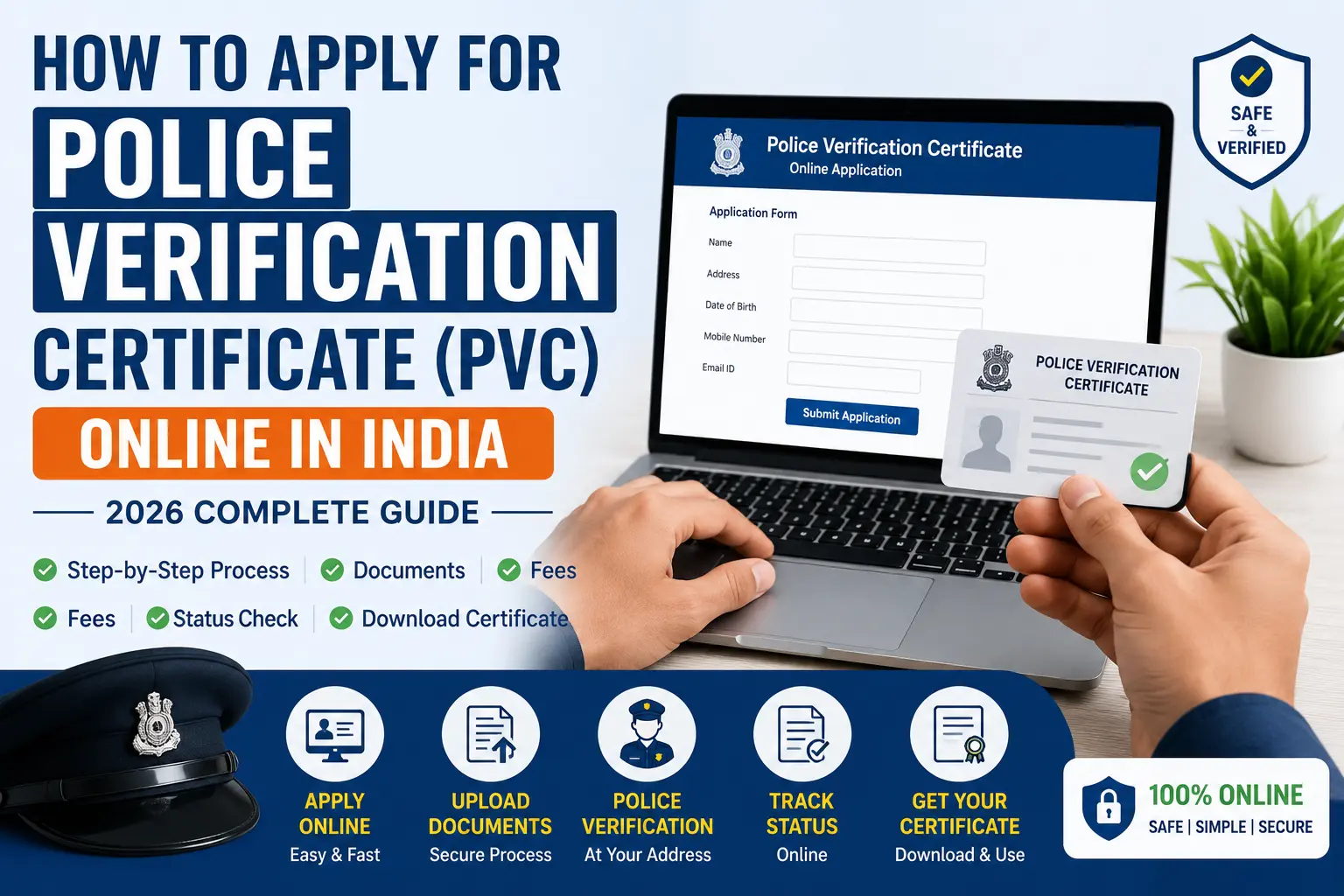
Getting a Police Verification Certificate Online Doesn’t Have to Be Confusing
Many employers, landlords, and passport applicants now require a Police Verification Certificate (PVC) or Police Clearance Certificate (PCC) as part of onboarding, tenancy, or visa processing. The good news: in 2026, most of this process happens online, from filling out the application to downloading the final signed certificate there’s no need to stand in line at a police station for most of it.
This guide covers what a police verification certificate actually is, how it differs from a Police Clearance Certificate (PCC), the documents you’ll need, how much it costs, how long it typically takes, and what to do if your application gets stuck.
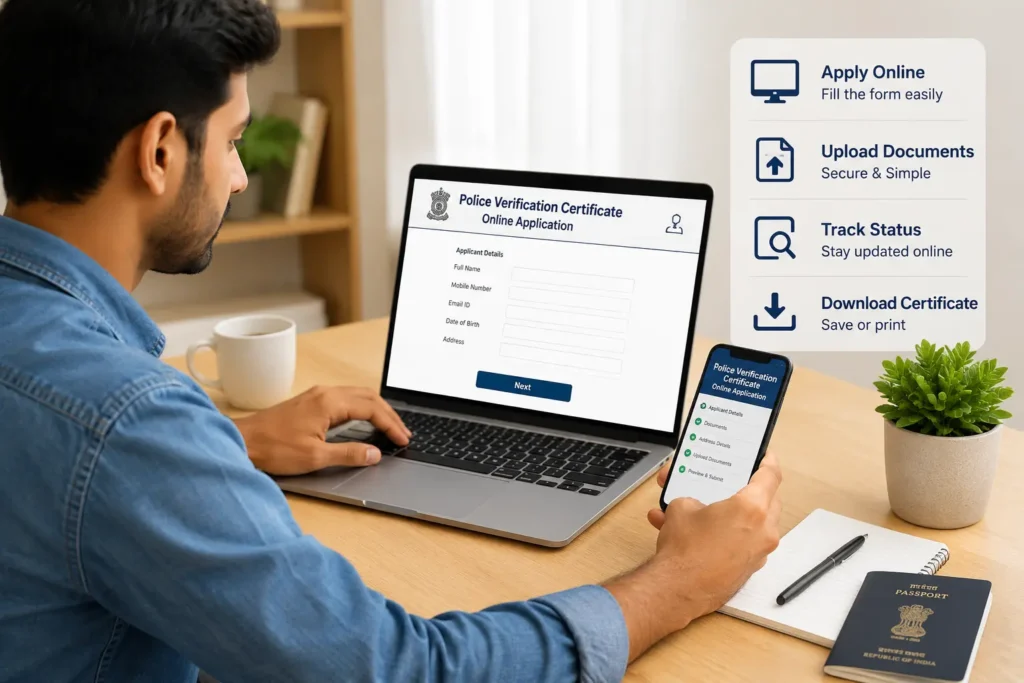
What Exactly Is a Police Verification Certificate?
A Police Verification Certificate (PVC) is an official document that confirms you don’t have any pending criminal case or adverse police record in a particular area. Depending on where you live, it might be called a Character Certificate, a Character Verification Report, or an Antecedent Verification Report the name changes from state to state, but the purpose stays the same.
This certificate is usually needed for things like:
- Government or private job verification
- Passport applications
- Visa and immigration processes
- Tenant verification when you rent out a property
- Domestic help or vendor background checks
- Higher education admissions abroad
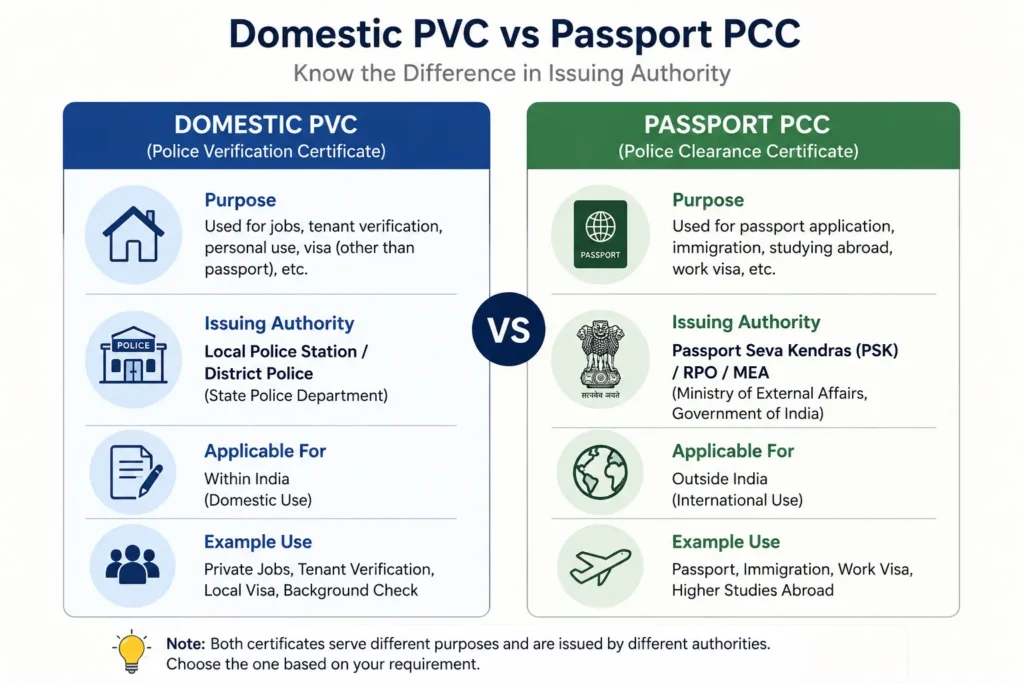
Police Verification Certificate vs. Police Clearance Certificate (PCC) Know the Difference First
This is the part that trips up most people. It’s easy to assume a domestic job-verification certificate and an international PCC are the same thing they’re not, and mixing them up can cost you time and money.
Here’s the distinction: if you’re applying for something within India a local job, a rented flat, a background check you need a domestic Police Verification Certificate, issued by your state police department. But if you’re applying for a job abroad, immigration, permanent residency, or a study visa, you need a Police Clearance Certificate (PCC), which is issued centrally by the Ministry of External Affairs (MEA) through the Passport Seva system.
State police can’t issue a PCC for you this was actually settled legally too. In a case before the Kerala High Court, it was clarified that state police authorities don’t have the power to issue a PCC for overseas use, since that’s a central government function under the Passport Rules, 1980. Following this, Kerala Police even renamed their domestic certificate to a “Certificate of Non-Involvement in Offences” to avoid confusion.
So before you fill any form, figure out which one you actually need. Submitting a state-issued PVC to a foreign consulate will just get rejected, and you’ll have to start over.
Documents You’ll Need for Police Verification
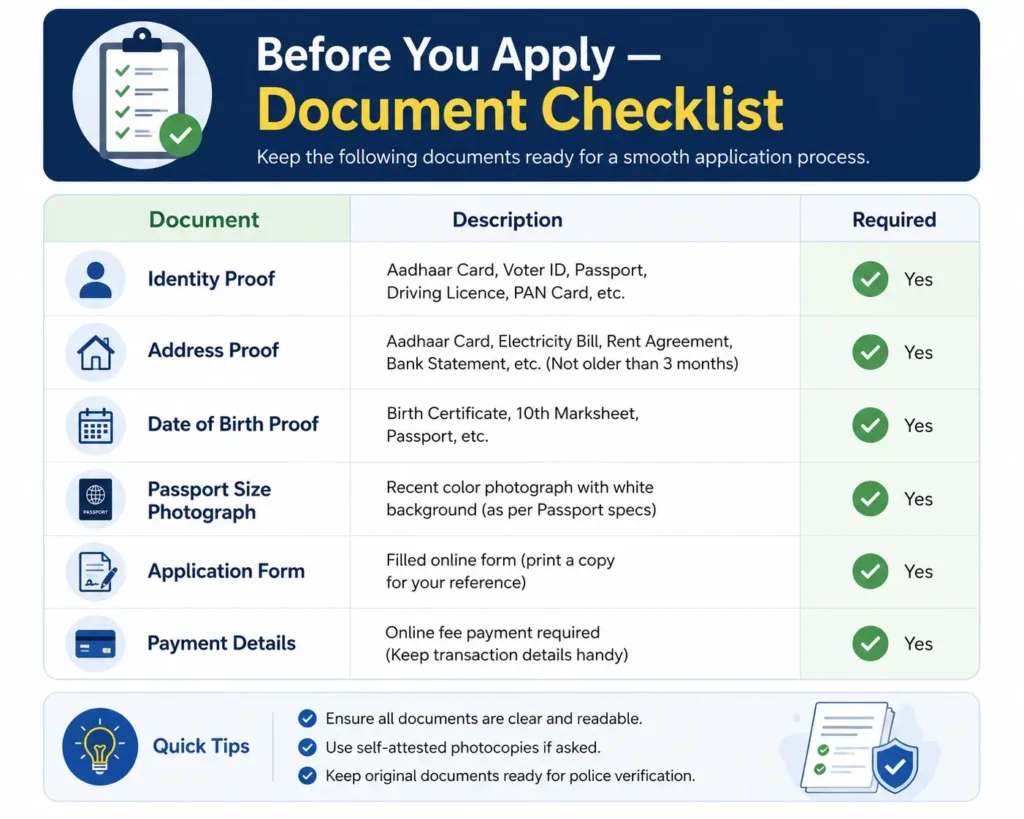
Keep your documents ready and scanned before you open the application form it saves back-and-forth later. Here’s what you’ll typically need for a domestic PVC:
Proof of Identity – Aadhaar Card, PAN Card, Voter ID, or Passport.
Proof of Address – Aadhaar Card (if it matches your current address), a recent utility bill (not older than 3 months), bank passbook with your photo, or a registered rent agreement if you’re a tenant.
Passport-size photograph – recent, front-facing, plain background, usually under 200 KB in JPEG format.
Signature or thumb impression scan – as per the specific size limits mentioned on the portal.
Two local references – names, addresses, and mobile numbers of neighbors who’ve known you for at least a year in the same police station limits.
If you’re applying for the international PCC through Passport Seva, you’ll additionally need self-attested copies of your passport’s first and last pages, and proof of why you need the PCC like a job offer letter or a visa application document.
For minors, parents’ passport copies, a birth certificate, and a signed consent letter from guardians are required. Foreign nationals living in India need to apply separately through the e-FRRO portal, and NRIs abroad need to go through the Indian Embassy or a VFS Global center.
How to Apply for a Police Verification Certificate Online, Step by Step
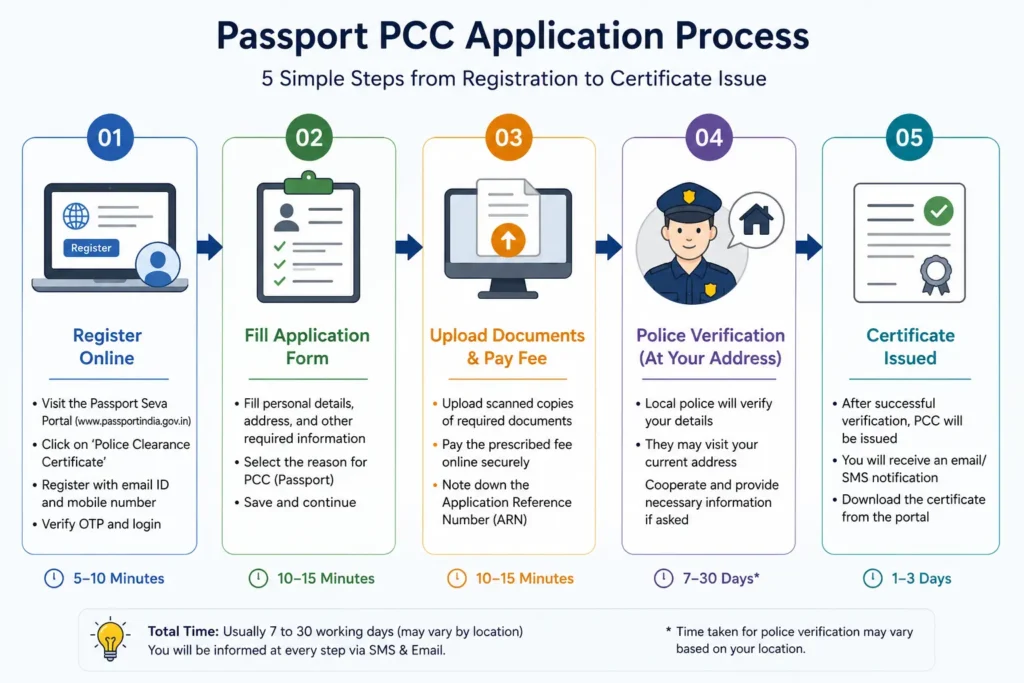
For Passport PCC (International Purpose)
- Register on Passport Seva – Go to passportindia.gov.in, click “Register Now,” pick your Regional Passport Office, and fill in your details. You’ll get an activation link on email click it to activate your account.
- Fill the PCC application – Log in, go to “Apply for Police Clearance Certificate,” and enter your passport details, personal info, family background, address history, destination country, purpose of travel, and reference details. Once submitted, you’ll get an Application Reference Number (ARN).
- Pay the fee and book an appointment – Head to “View Saved/Submitted Applications,” pay the ₹750 fee online (revised from ₹500 under the Passports (Amendment) Rules, 2026, effective July 1, 2026), and pick a Passport Seva Kendra (PSK) or Post Office PSK for your appointment.
- Visit the PSK – Carry your original documents. Your photo and fingerprints get captured, and once cleared, a Police Verification Request is sent to your local station.
- Local police verification – A beat officer visits your address, checks your documents, and talks to your listed references. This gets logged on the CCTNS system.
- Certificate issued – Once the report comes back clear, the Regional Passport Office releases your PCC.
For State/Domestic PVC
The exact portal name changes depending on your state, but the general flow is similar everywhere. For example, in Uttar Pradesh, you’d use the UP COP app register with your mobile number, go to “Services” > “Character Certificate,” fill in your details, upload documents, and pay a small ₹50 fee. In Delhi, it’s done through the dedicated PCC/CVR portal fees vary by application type, so confirm the current amount on the portal before paying. Maharashtra residents use the MahaOnline portal, and West Bengal has its own PCC portal that requires Aadhaar-linked mobile verification; fee structures for both are best confirmed on the respective portal, since they change from time to time.
If you’re not sure which portal applies to you, the Digital Police Portal (digitalpolice.gov.in), maintained by the National Crime Records Bureau, works as a directory just select your state, and it redirects you to the right site.
How Much Does Police Verification Cost?
Fees genuinely vary a lot depending on what kind of certificate you need and which state you’re in. The Passport PCC through the central MEA system has a flat fee of ₹750 across India, revised from ₹500 under the Passports (Amendment) Rules, 2026, effective July 1, 2026. State-level domestic PVCs are usually cheaper Uttar Pradesh charges just ₹50 through the UP COP app. Other states set their own fees, which can run higher for certain commercial or bulk categories, so check your state portal for the exact current amount.
Always pay through the official portal only. Third-party “agents” sometimes claim they can speed up the process for extra cash there’s no legitimate shortcut, and the police verification process doesn’t work that way.
How Long Does the Process Take?
Generally, Passport PCC applications take anywhere from 2 to 21 days, depending on whether your current address matches your passport records. If it does, it can be surprisingly fast. If there’s a mismatch, it takes longer because of additional field checks.
For state PVCs, most applications get processed within 7 to 21 days, though this depends on your state’s specific service guarantee. Tamil Nadu tends to be on the faster end, at around 3 to 5 working days, while Kerala’s NIO certificate process can take up to 10 working days.
Checking Your Police Verification Status and Downloading the Certificate
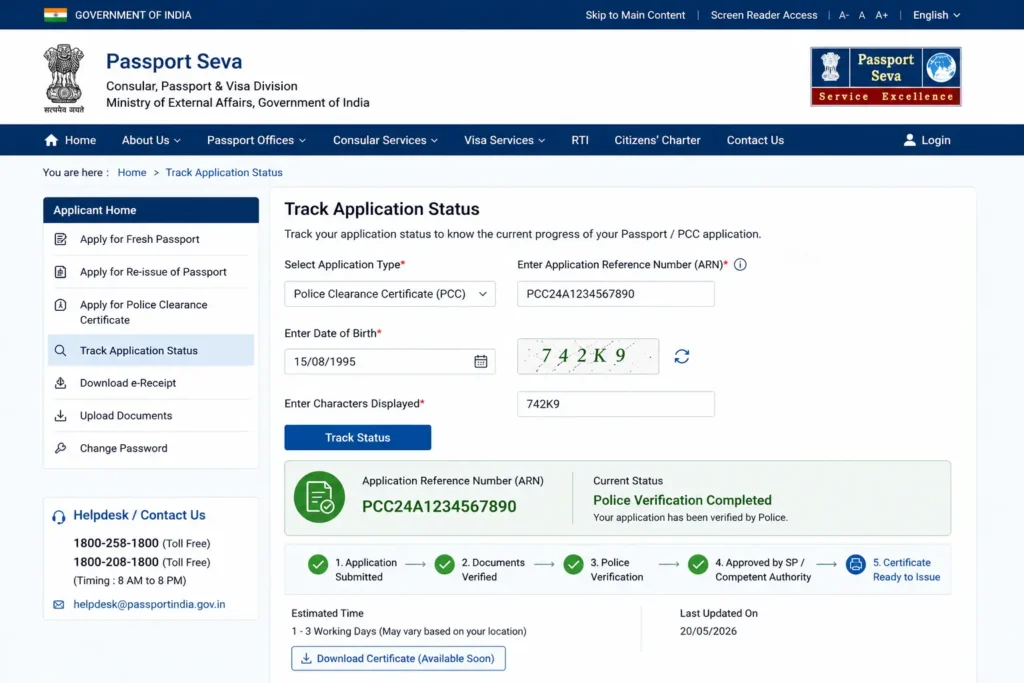
Once you’ve submitted your application, don’t just sit and wait check the status periodically. For Passport PCC, go to the “Track Application Status” section on passportindia.gov.in, select “Passport/PCC/IC/GEP,” and enter your 15-digit File Number along with your date of birth.
For state PVCs, you’ll usually find a “Track Status” option on your respective state portal, where you enter your Application Reference Number or Acknowledgement Number. Once it shows “Approved” or “Completed,” you can download your digitally signed certificate as a PDF straight from the portal.
One thing worth knowing these PDFs come with a digital signature backed by PKI (Public Key Infrastructure). If you open it in Adobe Acrobat and see “Signature Unverified,” you can go to the signature panel, click “Signature Properties,” then “Show Signer’s Certificate,” and add it to your trusted certificates. It’ll turn into a green checkmark once verified.
Validity of the Certificate
Here’s something people often overlook your certificate’s validity depends on who’s asking for it, not the issuing authority. Foreign embassies usually want a PCC issued within the last 6 months, while domestic employers and landlords are generally fine accepting certificates issued within the past 6 to 12 months. Tenant verification records typically stay valid for as long as the lease agreement runs.
Common Reasons Applications Get Delayed or Rejected
A few things trip people up again and again:
If you’ve lived at multiple addresses in the last 5 years, each one might need separate verification, which slows things down. Old, closed court cases sometimes still show up as flags in the CCTNS database until you submit discharge or acquittal proof. People with common names occasionally get flagged by mistake alongside someone else in the criminal database. And the most avoidable one small spelling mismatches between your Aadhaar, rent agreement, and application form. Even something like “Rd” vs “Road” has caused delays for applicants.
Triple-check that your name and address are written exactly the same way across every document before you submit.
What to Do If Your Application Gets Stuck
If your status shows “under process” for way longer than it should, don’t just keep refreshing the page. The most effective route is filing an application under the Right to Information (RTI) Act, 2005. Police stations are legally required to respond to RTI queries within 30 days, and delays can result in penalties for the concerned officer.
To file one, address it to the Public Information Officer at the Office of the Superintendent of Police or Commissioner of Police (Special Branch) of your district, attach the applicable RTI fee (₹10 under the central RTI framework some states set their own fee schedules, so confirm the exact amount for your state), and ask specific, direct questions like the current status of your reference number, the officer responsible, and reasons for the delay. Send it via Registered Post with Acknowledgement Due so you have proof it was received.
You can read more about how the RTI process works on the government’s official RTI portal.
Quick Tips Before You Apply
A few practical things worth keeping in mind before you start. Keep your reference contacts informed in advance a beat officer calling out of the blue can confuse people who forgot they were listed. Always double-check whether you need a state PVC or a central PCC before applying, since that single mistake wastes the most time. And keep digital and printed copies of every document you upload; you’ll likely need them again during your PSK visit or the officer’s home visit.
Frequently Asked Questions
What is a Police Verification Certificate (PVC)?
It’s an official document from a police department confirming you have no adverse criminal record or pending case in that jurisdiction.
How do I apply for a Police Verification Certificate online?
For international use, apply through the central Passport Seva portal. For domestic use, register on your state police department’s citizen portal or app, fill the form, upload documents, and pay the fee.
What documents are required for police verification?
A proof of identity (Aadhaar, PAN, Voter ID, or Passport), proof of address, a recent photo, and details of two local references.
How much is the police verification fee?
Passport PCC costs ₹500. State PVC fees range from ₹50 to ₹250 depending on the state.
How long does police verification take?
Passport PCC usually takes 2 to 21 days; state PVCs typically take 7 to 21 days.
Can I download my police verification certificate online?
Yes, once approved, you can download a digitally signed PDF certificate directly from the respective portal.
For related guides, check out our posts on paying electricity bills online in India.