

If you’ve paid your property tax online but the municipal portal isn’t showing a receipt, or you simply need a copy of one you paid earlier, this is a common problem. It usually comes down to a timing gap between your bank’s payment confirmation and the municipal server, or simply not knowing which menu the receipt is filed under.
The process itself isn’t hard once you know where to look. What trips people up is not knowing which number to type in, which tab to click, or which portal actually belongs to their city.
This guide walks you through exactly that. Whether you’re trying to do a property tax receipt download for a home loan, a property sale, or simply to keep your paperwork in order, I’ll show you how it works city by city, based on how the major Indian municipal portals are actually structured today.
Why Your Property Tax Receipt Matters More Than You Think
A tax receipt can seem like just a formality, something you glance at once and forget. But banks routinely ask for the last three to five years of payment proof before disbursing a home loan, and locating old receipts after the fact can be a hassle if you haven’t kept them.
An online property tax receipt isn’t just a piece of paper confirming you paid on time. Banks ask for it before disbursing home loans, because unpaid municipal dues can sit as a legal charge on the property. Buyers and their lawyers ask for it during resale, to confirm there’s no pending liability. It’s also needed for building plan approvals, new utility connections, and property mutation, which is the process of updating ownership records after a sale or inheritance.
So even if nobody’s asking you for it right now, it’s worth downloading your property tax paid receipt the moment you make a payment, rather than scrambling for it a year later.
What You Need Before You Start
Here’s the part that confuses most people, and honestly, it confused me the first time too. Every Indian municipal corporation uses its own unique identifier to track your property in its database. It’s not your name, it’s not your address exactly, it’s a specific number or code tied to your property file.
In Bengaluru, this is called the PID, or Property Identification Number, sometimes accompanied by an Application Number. In Delhi, it’s the UPIC, the Unique Property Identification Code, a 15-character alphanumeric string. Mumbai uses a Property Account Number, along with the CAPTCHA shown on screen to look it up. Ahmedabad uses what’s called a Tenement Number, a 15-digit alphanumeric code. Chennai’s system is a bit different, structured around a Zone number, Division code, Bill number, and Sub number. Hyderabad uses a Property Tax Identification Number, or PTIN.
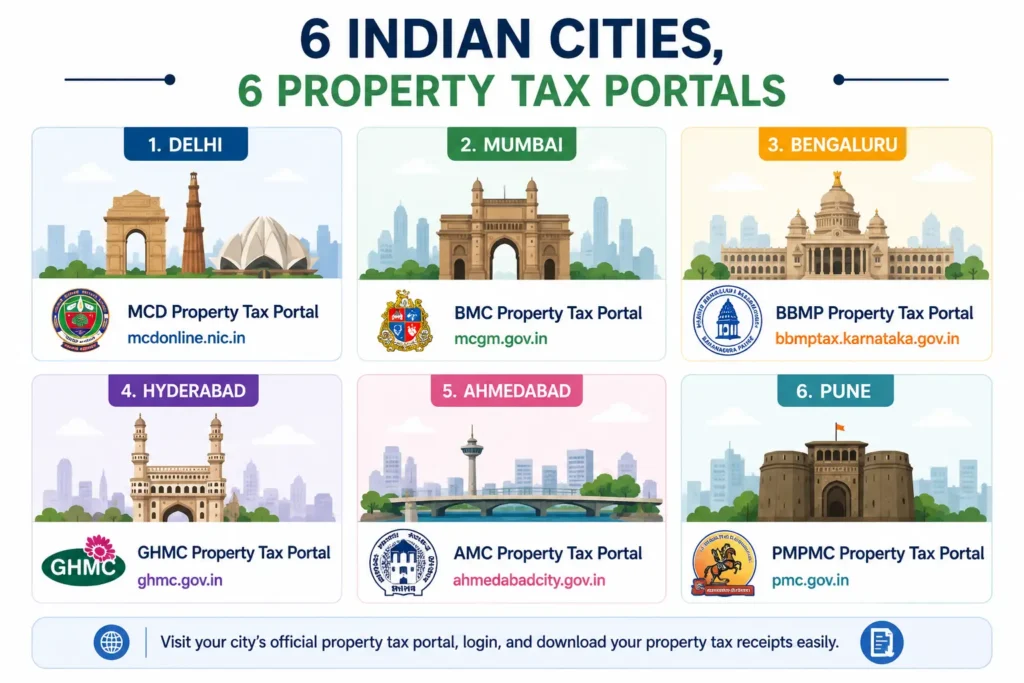
Here’s a quick reference table so you know what to look for before you even open the portal:
| City / Corporation | Identifier You Need | Official Portal |
|---|---|---|
| Bengaluru (BBMP) | PID or Application Number | bbmptax.karnataka.gov.in |
| Delhi (MCD) | UPIC (15-character code) | mcdonline.nic.in |
| Mumbai (BMC/MCGM) | Property Account Number or Contract No. | ptaxportal.mcgm.gov.in |
| Ahmedabad (AMC) | Tenement Number | ahmedabadcity.gov.in |
| Chennai (GCC) | Zone, Division, Bill & Sub Number | chennaicorporation.gov.in |
| Hyderabad (GHMC) | PTIN (10-digit) | ghmc.gov.in |
If you genuinely can’t find your number anywhere, don’t worry, I’ll cover that too a little further down.
City-Wise Guide: How to Download Property Tax Receipt Online
Let me walk you through each city’s process the way I’d explain it to a friend sitting next to me.
Bengaluru (BBMP)
Head over to bbmptax.karnataka.gov.in. On the main menu, look for the “Downloads” tab and choose “Receipt Print” from the drop-down that appears. You’ll be asked to enter either your 10-digit Application Number or your PID, then pick the assessment year you’re looking for. There’s a CAPTCHA to clear, and once you hit submit, the system pulls up your payment record. From there, clicking “View Document” or “Print Receipt” gives you the official PDF.
If you prefer using an aggregator app instead of the government site directly, platforms like mypatta also let you pull a BBMP receipt by entering the same Application Number or PID.
Delhi (MCD)
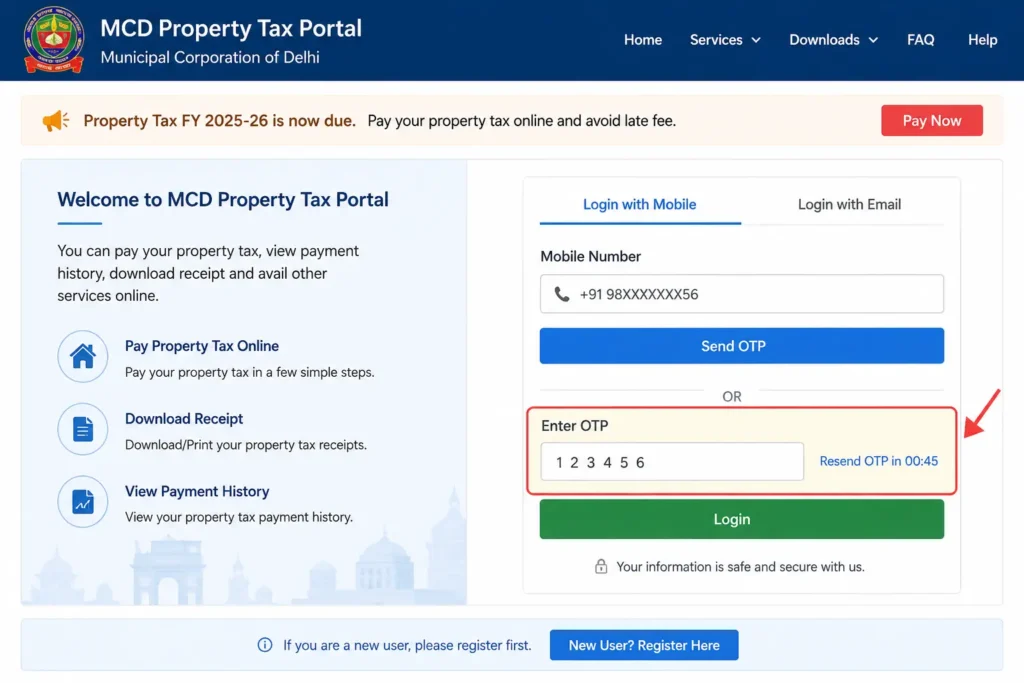
The unified MCD portal at mcdonline.nic.in handles property tax for the whole city now, after the earlier North, South, and East corporations were merged. Go to “Online Services,” then “Property Tax,” and you’ll land on the citizen login page.
If you’re a resident taxpayer, you’ll log in with your registered mobile number and an OTP. NRI taxpayers use an email ID and password, or an email-based OTP instead. One thing worth knowing: if you’re an NRI who’s since gotten an Indian SIM, you’ll need to raise a “UPIC Transfer Request” inside the dashboard to link your UPIC to your new number, and this needs officer approval before it goes through.
Once you’re in, your dashboard lists every property tied to your profile. Find the correct 15-character UPIC, click “Action,” then choose “Tax-Paid Details.” That opens your payment ledger, where you can pick the financial year and click “Download Receipt.” The UMA and MCD311 mobile apps offer the same functionality if you’d rather do this from your phone.
Mumbai (BMC/MCGM)
For Mumbai, the dedicated portal is ptaxportal.mcgm.gov.in, though you can also get there through portal.mcgm.gov.in. You’ll need your Property Account Number, along with the CAPTCHA shown on screen. If you don’t have it handy, the portal also lets you search by ward, name, or address.
Once you’re logged in, the portal shows your full assessment ledger, both outstanding dues and completed payments. Go to “Payment Receipt” or “View Outstanding/Paid Bills,” pick the transaction and year you need, and download the PDF. If you’d rather not deal with the website, the myBMC mobile app and the mybmc Assist chatbot on WhatsApp (+91 8999228999) can pull up the same records.
Ahmedabad (AMC)
You can download your receipt directly from the official AMC portal at ahmedabadcity.gov.in. Under “Online Services,” select “Download Property Tax Receipt,” and enter your 15-digit Tenement Number.
Once the system pulls up your property details, click “Paid Receipt.” This triggers an OTP sent to your registered mobile number, after which the receipt becomes available to download as a PDF. Apps like mypatta and Landeed also support Tenement Number lookups if you want an alternative to the government portal, though for anything involving your property details it’s worth sticking with the official AMC portal directly.
Chennai (GCC)
Chennai’s system works a little differently since it relies on location codes rather than a single number. On chennaicorporation.gov.in, go to “Online Tax Payment” and select “Property Tax Receipt Print.” You’ll need to enter your Zone number, your Division or Ward code, your Bill Number, and your Sub Number. Once submitted, your payment history shows up and you can export the receipt directly.
Hyderabad (GHMC)
For Hyderabad, visit ghmc.gov.in or the CDMA Telangana portal. Enter your PTIN, then verify the OTP sent to your registered mobile number. Once you’re through, you can select the financial year you need and download the official payment voucher.
How to Download an Old or Previous Year’s Property Tax Receipt
This comes up a lot when people are selling a property and the buyer’s lawyer asks for three to five years of payment history. The good news is that almost every portal I’ve listed above stores your full ledger, not just the most recent payment.
On each of these sites, once you’re inside your property’s payment history section, you’ll see a dropdown for financial year or assessment year. Pick the specific year you need, and the same “Download Receipt” or “Print Receipt” option will generate that year’s PDF. This works the same way whether you’re doing an old property tax receipt download for 2019 or one from last month. The only exception is if the property changed hands or was re-assessed years ago, in which case very old records sometimes need a manual request at the ward office.
Lost Your Property ID? Here’s How to Find It Anyway
If you’ve misplaced your PID, UPIC, Tenement Number, or PTIN, most portals still let you search using secondary details. This usually includes your name as the registered owner, the ward number, your street or locality name, the plot or door number, or the mobile number you used during a previous filing. It’s not always as instant as searching by property ID, but it almost always works, especially if you’ve paid tax on this property before, since the system already has your details on file.
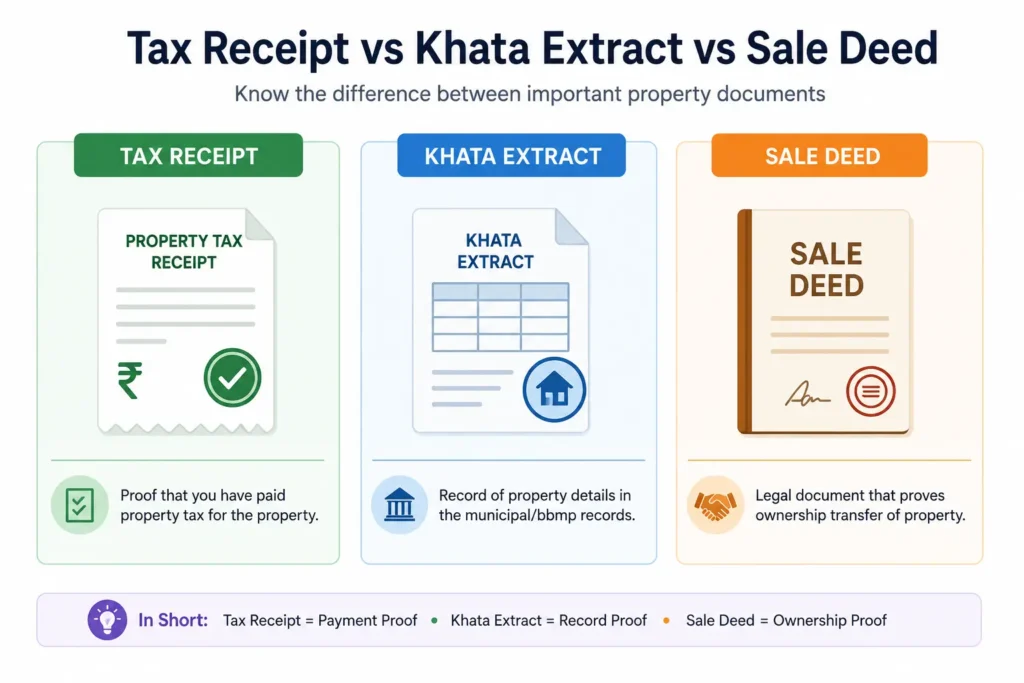
Property Tax Receipt vs Khata vs Sale Deed: Don’t Confuse These
This is a mix-up I see constantly, and it’s worth clearing up properly. A property tax receipt proves you’ve paid your dues for a given year. It is not proof of ownership. A Khata extract (or its equivalent, like the 8A in some states) confirms your property is recorded in the municipal assessment rolls. Also not proof of ownership. The only document that legally establishes who owns a property is the registered Sale Deed or Title Deed, issued by the state’s Registration and Stamps Department.
Banks typically want all three during a home loan process: the tax receipt to confirm there’s no municipal charge on the property, the Khata to verify assessment records, and the Sale Deed as the actual legal proof of title. If you’re prepping documents for a loan, it’s worth reading through fixmydaily.com/home-loan-documents-checklist alongside this guide, since the two often go hand in hand.
Paid But No Receipt? Here’s What to Do
This is more common than you’d think. Money leaves your account, but the municipal portal still shows the payment as “Pending,” “Failed,” or “Awaiting Clearance.”
Usually, this happens because of a timing gap between your bank’s payment gateway and the municipal server. If the confirmation signal doesn’t reach the municipal system in time, it marks the transaction as unverified, even though your money has already moved.
The first thing to do is note down everything: your bank’s debit reference, the payment gateway transaction ID, and if available, the UTR or trace number. The second thing, and this is important, is to not pay again immediately. Most municipal systems automatically re-check unverified transactions with the payment gateway within 24 to 48 hours, and paying twice usually just means you now have to chase a refund instead of a receipt.
Speaking of refunds, BBMP, for instance, states that duplicate payments caused by gateway errors are refunded automatically within 10 working days. If your payment genuinely failed and never reached the municipal account, your bank usually reverses it on its own.
If 48 hours pass and you’re still stuck, raise a formal complaint. On BBMP’s portal, this means going to “Grievance,” then “Raise Ticket,” and selecting “Online Payment Related Issue.” BMC users can call the helpline at 1916 or use the mybmc Assist chatbot. MCD taxpayers can email their transaction details to the IT helpdesk at mcd-ithelpdesk@mcd.nic.in. It’s a bit of waiting, but the receipt typically shows up within a few days without needing to repay.
A Few Practical Tips Before You’re Done
Save every receipt the moment you get it, and name the file properly, something like PropertyID_2026_AMC, rather than “download (1).pdf.” You’ll thank yourself later when a bank or buyer asks for five years of records at once.
It’s also worth checking if your city offers early payment discounts. Ahmedabad, for example, gives a 12% rebate for advance payment, plus an extra 1% for paying digitally, and a further 2% loyalty rebate if you’ve paid online for three consecutive years, which can add up to a 15% total saving. Before you pay next year, it’s worth checking your city’s current rebate structure, since these do get revised from time to time.
One more thing: double-check that your property details on the portal, like built-up area or floor additions, match your actual property. A mismatch here doesn’t just cause a wrong tax bill, it can cause real headaches later during a sale or mutation. If you’ve recently updated ownership records, our piece on fixmydaily.com/aadhaar-card-download-online might also be useful, since address-linked documents often need to be kept in sync.
Frequently Asked Questions
Can I download my property tax receipt using just the property ID?
What if I only have my assessment number and not the exact property ID?
Can a tenant download the property tax receipt?
Is a downloaded PDF receipt legally valid, or do I need a physical stamp?
What if my name is spelled incorrectly on the receipt?
Final Thoughts
Once you know your property ID and which portal your city uses, downloading a property tax payment receipt online really is a five-minute job. The confusion almost always comes from not knowing where to look, not from the process itself being complicated. Keep your identifiers saved somewhere safe, download your receipt every year as soon as you pay, and you’ll never be stuck scrambling for one when a bank or buyer asks.