

Most municipal corporations in India from Delhi to Bengaluru to Ahmedabad have moved property tax payment online. Even so, most people get stuck at the same few points: they can’t find their property ID, aren’t sure which portal applies to them, or hit a payment failure with no clear next step.
This guide walks through how to pay property tax online in India in 2026, city by city, along with common mistakes to avoid and the rebates many owners don’t realise they’re eligible for.
Why Paying Property Tax Online Actually Makes Sense
Property tax is the money that keeps your city running. It funds road repairs, streetlights, garbage collection, and local hospitals. For years, this system ran on paper ledgers and cash counters, which meant long queues, lost receipts, and a fair bit of confusion about how much you actually owed.
Most municipal corporations have now built dedicated web portals, and several states run a unified platform that covers multiple cities at once, like Gujarat’s eNagar system. These portals use digital mapping and centralized databases to track every property, which is honestly a huge improvement. You can check your dues, pay instantly, and download a receipt, all without stepping outside.
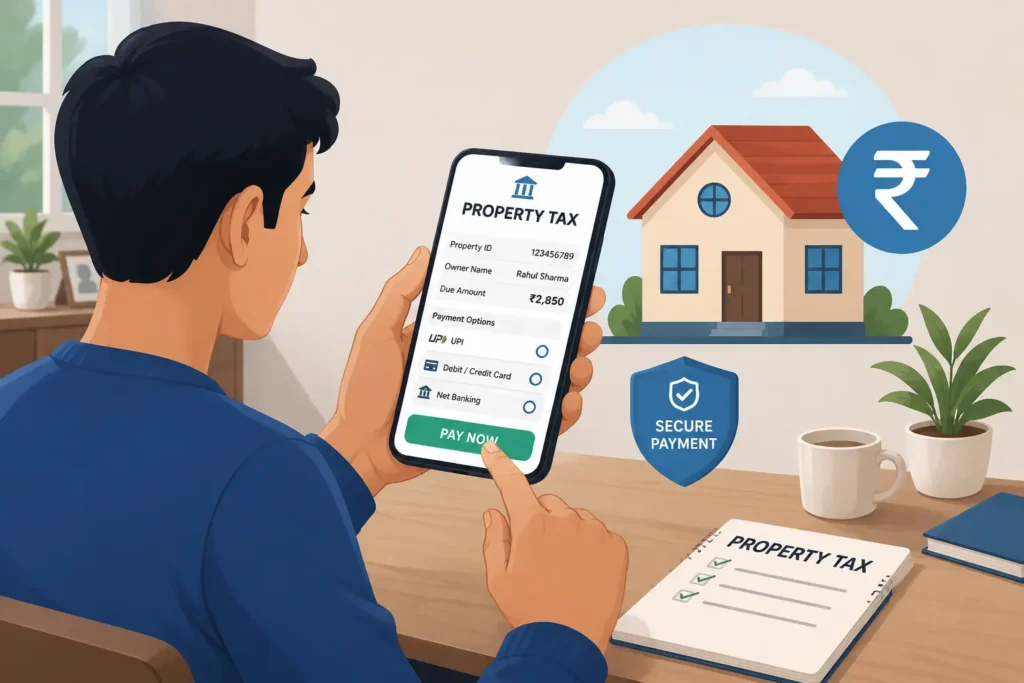
Step 1: Find Your Property ID, the Number That Unlocks Everything
Before you can pay anything, you need one specific number. Every city calls it something different, and this trips up a lot of first-time payers.
Here’s what to look for depending on where your property is:
| City | What It’s Called | Where You’ll Use It |
|---|---|---|
| Delhi (MCD) | UPIC (Unique Property Identification Code) | 15-digit code, used on the MCD portal |
| Ahmedabad (AMC) | Tenement Number | 15-digit code printed on your annual Vera Bill |
| Mumbai (BMC/MCGM) | SAC or Property Account Number | Ward and parcel-specific code |
| Pune (PMC) | Property Account Number / Peth ID | Combines Ward ID, Section ID, and Account Number |
| Bengaluru (BBMP) | PID or SAS Number | Self-Assessment Scheme identifier |
| Hyderabad (GHMC) | PTIN | 10-digit number linked to your door number |
| Surat (SMC) | Tenement Number | Managed through Gujarat’s eNagar portal |
| Bhubaneswar / Odisha ULBs | Assessment or Holdings ID | Centralized under the Odisha Housing and Urban Development Department |
If you’ve misplaced this number, don’t panic. Check any old paper tax receipt, your registered sale deed, or use the “search by ward and address” option that most portals offer. You can usually find your property by selecting your zone, street, and building or society name instead of typing the ID directly.
How Property Tax Is Actually Calculated
Property tax isn’t calculated the same way in every city, and understanding the basic logic helps you spot errors on your own bill.
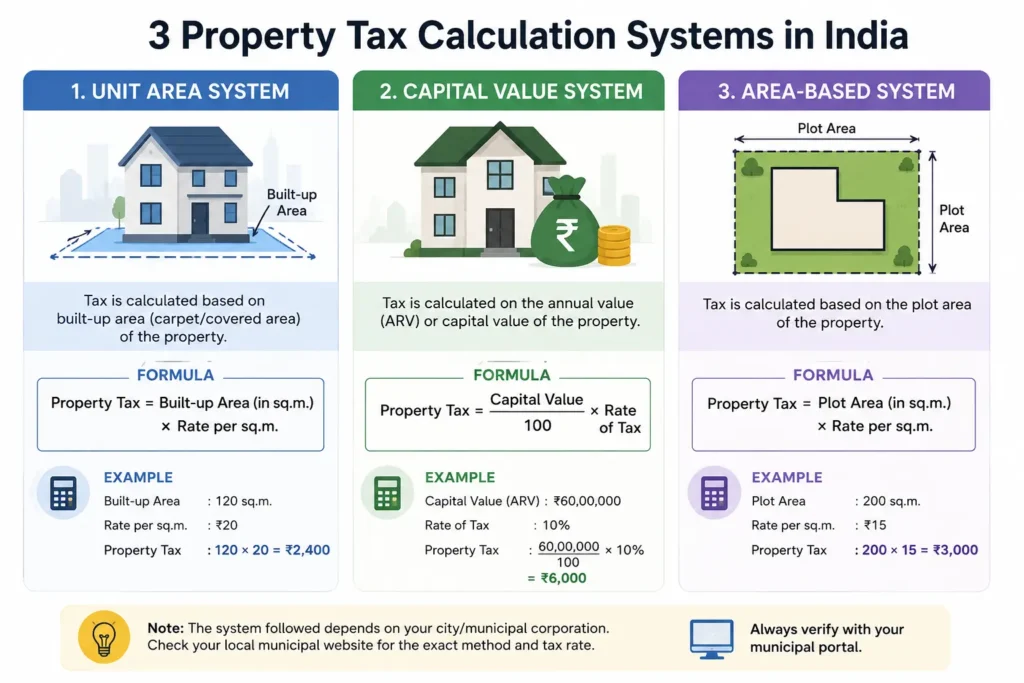
Most cities use one of three systems. Delhi uses the Unit Area System, where your area is assigned a base value depending on which category your colony falls under, from premium A-category zones to lower-value H-category ones. That base value is then adjusted for the age of your building, how you use it, and whether you live in it or rent it out.
Cities like Pune and Mumbai use the Capital Value System instead, where your tax is calculated as a percentage of your property’s estimated market value, based on the state’s official Ready Reckoner Rates. Ahmedabad uses a simpler area-based formula, applying a fixed rate per square metre currently around ₹16 for residential and ₹28 for non-residential properties and then adjusting it for location, usage, age, and whether you occupy it yourself.
The exact formula matters less than this one habit: always check that your recorded carpet area, floor, and usage category (self-occupied versus rented) are correct. Bills can end up inflated when a property’s usage category wasn’t updated after a change for example, a flat still marked “commercial use” after being converted back to residential.
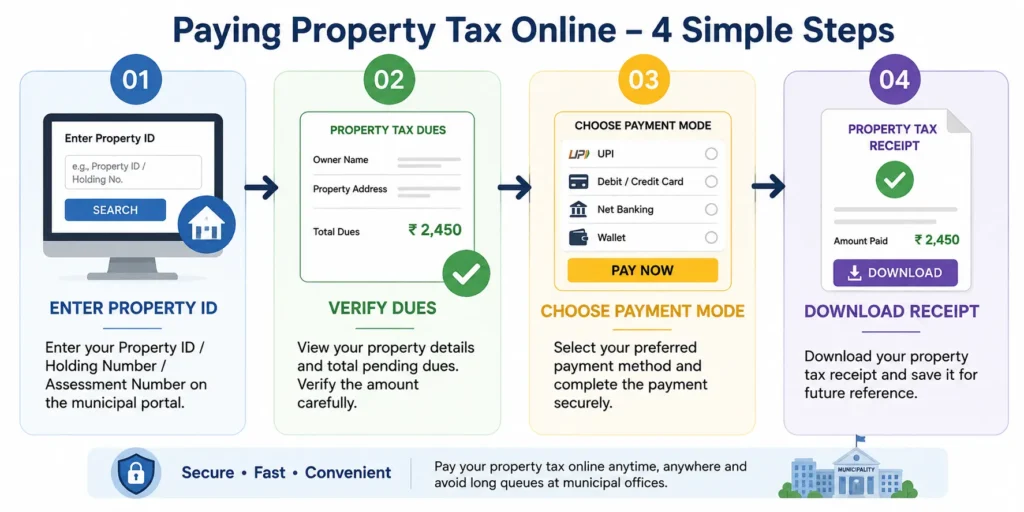
The Simple 4-Step Process to Pay Property Tax Online
Once you have your property ID, the online payment process is largely similar across city portals. Here’s how it goes.
Step 1: Go to the official portal and enter your property ID. Look for a “Pay Property Tax” or “Quick Pay” option. Most portals let you pay without creating an account, just by entering your Tenement Number, UPIC, PID, or PTIN. Creating a citizen login is worth it if you plan to pay every year, since it saves your payment history and past receipts in one place.
Step 2: Check your dues carefully before paying anything. This is the step people skip, and it’s the one that causes the most trouble later. Confirm your name and address match your ownership documents, check that the carpet area and usage type are correct, and look at the breakdown between current dues, old arrears, and any penalty. Also check whether your early-payment or online-payment rebate has already been applied to the amount shown.
Step 3: Choose your payment method. UPI is instant and usually has no extra charge, which makes it a common choice for regular residential bills. Net banking tends to be stable even during high-traffic periods like the last week of the rebate window. Debit and credit cards work too, though card networks like Visa and Mastercard can add a small processing fee. For big commercial properties or bulk arrears, RTGS or NEFT bank transfers are often used, though these can take a few hours to reflect.
Step 4: Download your receipt immediately. Once the payment goes through, the portal generates an e-receipt with a Transaction Reference Number, timestamp, and a full breakdown of your bill. Save this PDF somewhere safe. You’ll need it if you ever sell the property, apply for a home loan, or need to prove your municipal property tax payment is up to date.
If you want a faster way to track this each year, bookmark your city’s portal alongside our own property-tax-calculator tool below, which helps you estimate your dues before you log in to pay.
Municipal Property Tax
Property Tax Estimator
Get a ballpark figure for your annual property tax before you log in to pay. Works for any Indian city.
Assessment Summary
Ahmedabad · Residential
| Base rate | ₹16.00 / sq.m |
| Built-up area | 92.90 sq.m |
| Occupancy factor | × 1.00 |
| Age factor | × 1.00 |
| Structure factor | × 1.00 |
Estimated annual tax
₹ 1,486
This is a planning estimate only, built from general municipal formulas. It is not an official bill. Your municipal corporation’s own assessment is final — confirm exact dues on your city’s property tax portal before paying.
City-by-City Guide to Municipal Property Tax Online Payment
Here's how the process and rebate structure work out across some of the country's largest cities. Rebate percentages, deadlines, and scheme names change from year to year, so always confirm current figures on the official portal before paying.
Ahmedabad (AMC)
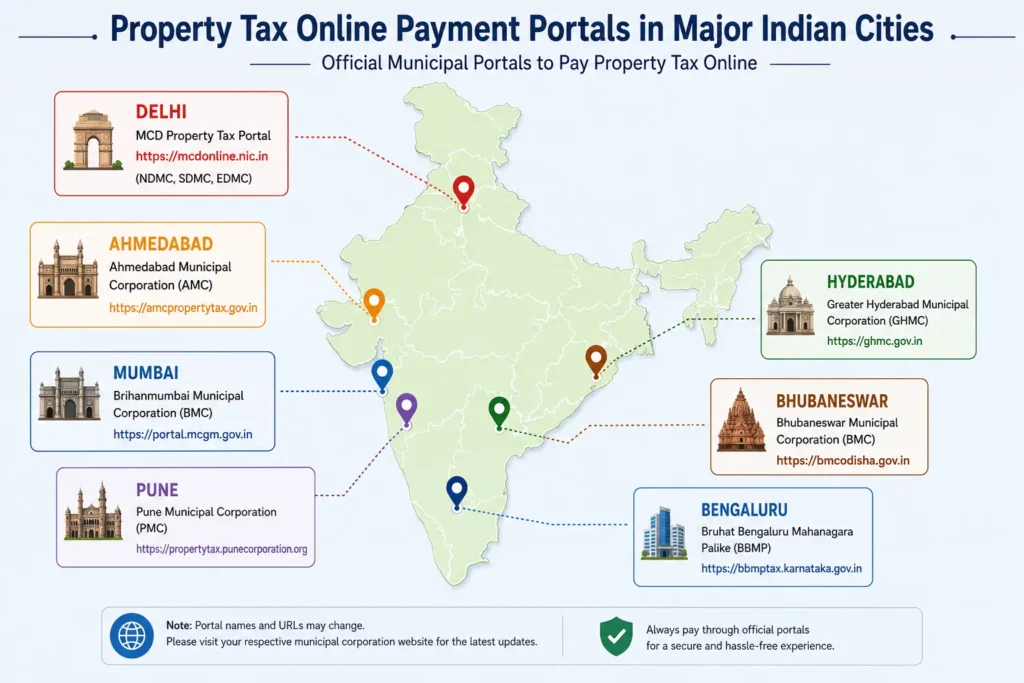
Ahmedabad's property tax locally called the Vera Bill is paid through the AMC portal at ahmedabadcity.gov.in. For FY 2026-27, AMC's rebate structure is one of the more generous in the country: a 12% base rebate for paying both instalments in advance, plus 1% for paying online, plus 2% if you've paid online for three consecutive years up to 15% off in total, if all conditions are met. The advance-payment window and exact dates change every year (it has recently run roughly April through end of May), so check the current window on the AMC portal before paying. Miss the deadline, and AMC charges 2% interest per month on the outstanding amount; continued non-payment can eventually lead to property attachment or sealing under the Gujarat Municipal Corporation Act.
Delhi (MCD)
Delhi's property tax runs through mcdonline.nic.in and the MCD 311 app, using the Unit Area System with colonies classified from Category A to H. MCD has also periodically run an amnesty scheme called SUNIYO, which lets owners clear years of pending dues by paying only the principal for the current year plus a few prior years, with older arrears and their interest/penalty fully waived. Scheme terms, eligible years, and deadlines change with each edition, so check the current SUNIYO terms (or whichever scheme is active) directly on the MCD portal. MCD has also offered rebates for senior citizens, women owners, and ex-servicemen on self-occupied properties in the past confirm current eligibility and percentages on the portal, since these are revised.
Pune (PMC)
Pune's portal at propertytax.punecorporation.org uses a combined Peth ID, Section ID, and Account Number. The standout rebate here is a 40% discount on self-occupied residential properties, claimed through a PT-3 form along with proof like a utility bill or society NOC properties registered before April 2019 generally get it automatically. Women, ex-servicemen, and freedom fighters (and their spouses) can get a 50% concession, and residents with 40%+ disability can get a 40% rebate. PMC also offers a separate 5–10% discount for paying the full year's dues by the early-payment deadline (commonly end of May, though this shifts year to year) confirm on the portal whether any additional rebate currently applies for green-building or water-saving features, since this isn't consistently documented across years.
Bengaluru (BBMP) and Hubli-Dharwad (HDMC)
Bengaluru property owners use bbmptax.karnataka.gov.in with their Self-Assessment Scheme PID, and BBMP has offered a rebate (recently around 5%) for paying the full year's dues early in the financial year confirm the current percentage and window on the portal. One issue worth knowing about: duplicate PID numbers. When a property changes hands or gets subdivided, the system can sometimes generate a new PID without cancelling the old one, so dues quietly keep accumulating on the forgotten ID. If this happens, raise it through BBMP's grievance section or your local BBMP office, with your sale deed and old receipts as proof.
Hyderabad (GHMC)
GHMC uses a 10-digit PTIN on ghmc.gov.in. Their Early Bird Scheme has offered a 5% rebate for paying within the scheme window (typically in April) confirm current dates on the portal. GHMC and the Telangana state government have also run one-time settlement (OTS) schemes offering interest waivers for clearing old arrears; the waiver percentage and terms vary by scheme edition, so check the current announcement on the GHMC site rather than relying on past figures.
Mumbai (BMC/MCGM)
Mumbai's civic body collects tax through ptaxportal.mcgm.gov.in using your SAC or Property Account Number, under the Capital Value System. Residential units up to 500 square feet carpet area have been fully exempt from property tax since 2022, with a 60% concession for units between 500–700 sq ft. In March 2026, BMC approved a proposal to raise the full exemption threshold from 500 to 700 sq ft this change may or may not be in effect yet, so confirm the current threshold on the portal before assuming your unit qualifies.
Surat (SMC) and Rajkot (RMC)
Surat property owners can pay through enagar.gujarat.gov.in using their 15-digit Tenement Number. Rajkot uses rmc.gov.in with a location-based formula. Both cities offer early-payment rebates and charge monthly interest on overdue amounts, broadly similar in structure to Ahmedabad's system check each portal directly for the exact current percentages, since these are revised periodically.
Bhubaneswar and Odisha ULBs
Property tax across Bhubaneswar and other Odisha towns is centralized through ulbodisha.gov.in. You'll need your assessment or holdings ID to check dues, and payments can be made by UPI, card, or net banking with an instant receipt.
What to Do When Your Payment Fails But Money Gets Deducted
Watching money leave your account with no receipt to show for it is stressful, but there's a clear process to follow.
First, save the Transaction Reference Number or bank UTR shown on the payment screen before you close the tab. Don't pay again immediately. Municipal portals reconcile with banks in batches, and it can take up to 48 hours for the payment status to update. After two days, go back to the "Payment Status" or "Download Receipt" section and search using your property ID along with that reference number. If it's still showing as failed and the money hasn't bounced back to your account, raise a ticket with the municipal IT helpdesk and attach your bank statement as proof.
When the Receipt Still Shows the Previous Owner's Name
If you recently bought a property and paid the tax using the existing property ID, don't be surprised if the receipt still carries the seller's name. Paying the bill does not automatically transfer ownership in municipal records. You'll need to file a separate mutation application, usually through the same portal, uploading your registered sale deed, Index II document, latest tax receipt, and a society NOC. Once the zonal officer approves it, future bills will finally show your name. It's worth starting this the same week you close the purchase, since it can take a few weeks to process and you don't want it hanging over you during a resale later.
Mismatch Between Your Online Receipt and a Physical Notice
Occasionally you'll get a physical notice claiming dues that your online receipt says are already cleared. This usually comes down to a sync delay between offline records and the central database, or a retroactive change in your property's valuation. Don't ignore these notices, since unaddressed ones can trigger automatic penalties. Log into the grievance section of your portal, reference the notice number, and upload your zero-balance receipt. If it turns out to be a valuation dispute, you'll need to file a formal review request with your ward's Assistant Assessor.
How to Actually Save Money on Your Property Tax
Timing matters more than most people realize. The first quarter of the financial year April through June is when almost every rebate is available at once.
Paying your full annual amount up front instead of splitting it into instalments locks in the biggest early-bird discount. Doing it online adds another 1 to 2% on top in most cities. And if your city offers a loyalty bonus for consistent online payment, like Ahmedabad does, that adds up over a few years.
It's also worth checking whether you qualify for a special category concession. Senior citizens, women property owners, and persons with disabilities can often claim a rebate on a self-occupied home in cities like Delhi and Pune check current percentages on your city's portal, as these vary and change over time. And if you're carrying old arrears, keep an eye out for amnesty schemes like Delhi's SUNIYO or Hyderabad's OTS, which have historically waived a significant share of accumulated interest for people who clear their principal dues exact terms differ by edition, so verify before assuming you qualify.
Why This Matters Beyond Just Avoiding Penalties
Your property tax receipt isn't just proof you paid a bill, it's part of your property's legal paper trail. Banks ask for it during home loan approvals, buyers ask for it before signing a sale agreement, and in most states, unpaid tax attaches to the property itself rather than the individual owner. That means if you buy a property with old dues still pending, you inherit that liability, interest and all.
If your dues have been fully cleared, it's worth requesting a Nil Dues Certificate from your municipal corporation before any sale or loan process, since it formally confirms there's no legacy tax attached to the property. On the other end, municipalities do have real enforcement power here, including monthly interest penalties, water connection disconnection, and in serious default cases, a lien or public auction of the property.
Quick Recap Before You Log In
Paying property tax online in India in 2026 really comes down to four habits: know your property ID and keep it saved somewhere permanent, pay within the early window to catch every available rebate, double check your assessment details each year, and download your receipt the moment the payment clears. Do these four things consistently, and you'll avoid most of the headaches that trip up first-time payers.